
Migrating from SD-WAN to SASE: A 90-Day Playbook for IT Infra Managers
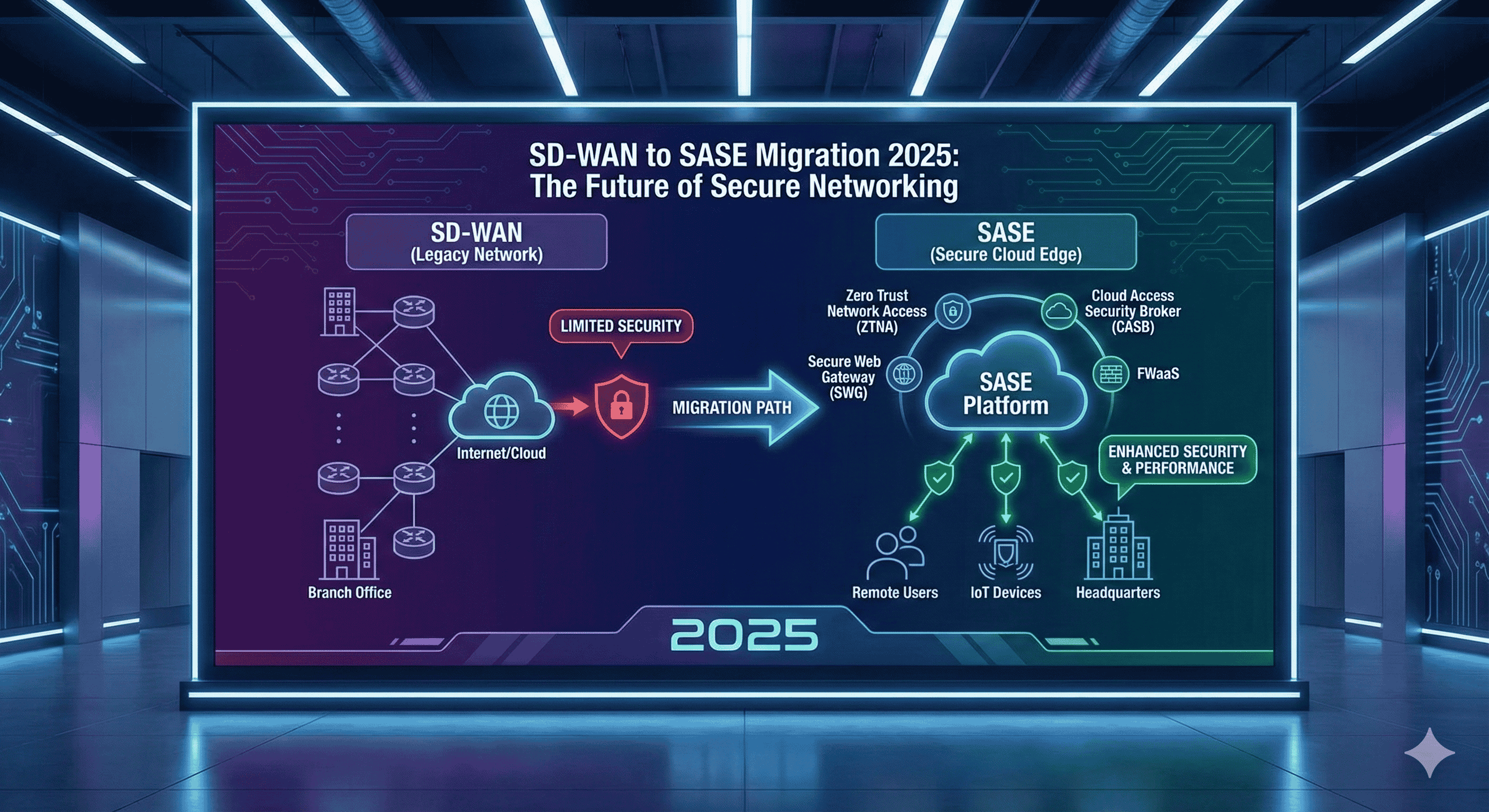
Most Indian enterprises deployed SD-WAN for better bandwidth control and cost savings, but in 2025, SD-WAN alone is no longer enough. With remote work, SaaS-heavy environments, and rising cyberattacks, IT Infra Managers are under pressure to modernize their network stack without business disruption.
This 90-day migration playbook offers a practical, execution-ready roadmap—from auditing the current SD-WAN fabric to adopting identity-first access, redesigning routing models, shifting from VPN to ZTNA, selecting the right SASE PoPs, and managing rollout workflows across branches.
If you’re leading a transition from SD-WAN to SASE, this is your blueprint.
1. Audit Phase (Days 1–15)
A successful migration starts with ground truth visibility of the current SD-WAN environment.
1.1 Inventory of existing environment
MPLS circuits, broadband links, LTE uplinks
Branch firewall models + software versions
SD-WAN controllers, CPE devices
Current QoS, steering policies
VPN concentrators & load distribution
1.2 Traffic flow + dependency mapping
Map:
SaaS traffic
Cloud workloads
Internal apps
Guest traffic
Branch-to-branch flows
1.3 Security posture analysis
Check:
Encrypted traffic inspection gaps
SWG/CASB coverage gaps
Lateral movement exposure
Lack of identity-based segmentation
1.4 Identify choke points
Typical SD-WAN bottlenecks:
Backhauling to data center for security
Inconsistent branch policies
High latency for Office 365, Salesforce, SAP, etc.
Also Read: SASE Architecture Blueprint for Indian Enterprises (2025)
2. Identity-First Approach (Days 15–30)
Migrating to SASE requires identity > network.
2.1 Move away from IP-based controls
SD-WAN policies often rely on:
Source IP
Subnet tagging
VLAN segmentation
SASE shifts control to:
User identity
Device posture
Risk score
Least privilege access
2.2 Integrate IAM + IdP
Before rollout, integrate:
Azure AD / Google Workspace / Okta
MFA
Conditional access
Device compliance policies
2.3 Define identity-based segmentation
Segment:
Contractors
Developers
Finance
OT/ICS devices
Partners
This becomes the backbone of ZTNA and app-level controls.
3. Branch Routing Model (Days 30–45)
This is where SD-WAN meets SASE.
3.1 Choose routing strategy
Three primary models:
Model A — Direct-to-PoP (Recommended)
Traffic from branches goes to nearest SASE PoP for:
Security inspection
Policy enforcement
Cloud breakout
Best for:
SaaS-heavy and multi-site enterprises.
Model B — Hybrid PoP + DC
Critical internal apps route to DC.
Everything else routes to PoPs.
Best for:
Enterprises with large on-prem workloads.
Model C — Phased per-site migration
Move low-risk branches first, critical sites later.
Best for:
Large distributed networks with >20 branches.
3.2 Define SLAs for branch cutover
PoP latency (must be <20ms ideally)
Failover route plans
CPE firmware alignment
Traffic steering logic
Also Read: SASE Architecture for Multi-Site Enterprises
4. VPN to ZTNA Cutover Plan (Days 45–60)
You can’t migrate to SASE without replacing VPN for users first.
4.1 Hybrid mode (VPN + ZTNA)
Run both temporarily; gradually shrink VPN usage.
4.2 App-by-app ZTNA migration
Start with:
Internal web apps
SaaS management portals
Dev servers
Partner portals
Then move to:
Critical business apps
HRMS / ERP / Finance
OT systems (if applicable)
4.3 User groups cutover plan
IT + power users
Developers
Corporate staff
Field teams
Contractors/vendors
4.4 Decommission VPN concentrators
Only when:
All apps migrated
All users shifted
Monitoring baseline established
Policy tuning completed
Outcome:
Your risk window from lateral movement shrinks dramatically.
Also Read: SASE vs VPN 2025
5. SASE PoP Planning (Days 60–75)
PoP selection directly impacts performance.
5.1 Verify PoP presence near your branches
Critical PoPs for Indian enterprises:
Mumbai
Chennai
Hyderabad
Bengaluru
Delhi NCR
5.2 Validate throughput + SLAs
Ask vendors for:
PoP latency benchmarks
Packet loss reports
Private backbone routes
Peak hour performance data
5.3 Evaluate backbone advantage
Vendors using private backbones (like Cato, Aryaka) deliver:
Lower jitter
Predictable throughput
Shorter SaaS round-trip time
5.4 Redundancy planning
Dual PoP connections
Failover routing logic
Automatic RTO policies
Also Read: FWaaS Providers Compared
6. Rollout Workflows (Days 75–90)
A predictable execution plan ensures zero business disruption.
6.1 Branch rollout sequence
Low-traffic branches
Medium branches
High-traffic hubs
Data center
6.2 Communication templates
Prepare:
User training guides
App access changes
Expected downtime window
Quick troubleshooting workflows
6.3 Validate security + performance KPIs
ZTNA login latency
PoP RTT
Branch traffic distribution
SLA adherence
Policy enforcement accuracy
6.4 Shift to BAU Mode
Hand over final configuration to:
SOC
Network team
IT Ops
Compliance teams
Outcome of the 90-Day Playbook
Centralized SASE policies
App-level access
Lower latency for SaaS
Reduced VPN dependencies
Better threat visibility
Stronger compliance posture