
SASE vs VPN: Advantages and Disadvantages and the Best Remote Access Security in 2025
VPN Problems That Security Heads Face in 2025
Slow access when users connect from smaller cities
VPN tunnels fail or crawl during peak hours
No traffic inspection inside VPN, only transport
Breach impact spreads fast due to flat network trust
IT teams spend too much time fixing VPN clients, certificates, and throughput limits
What is SASE vs VPN remote access security comparison really about?
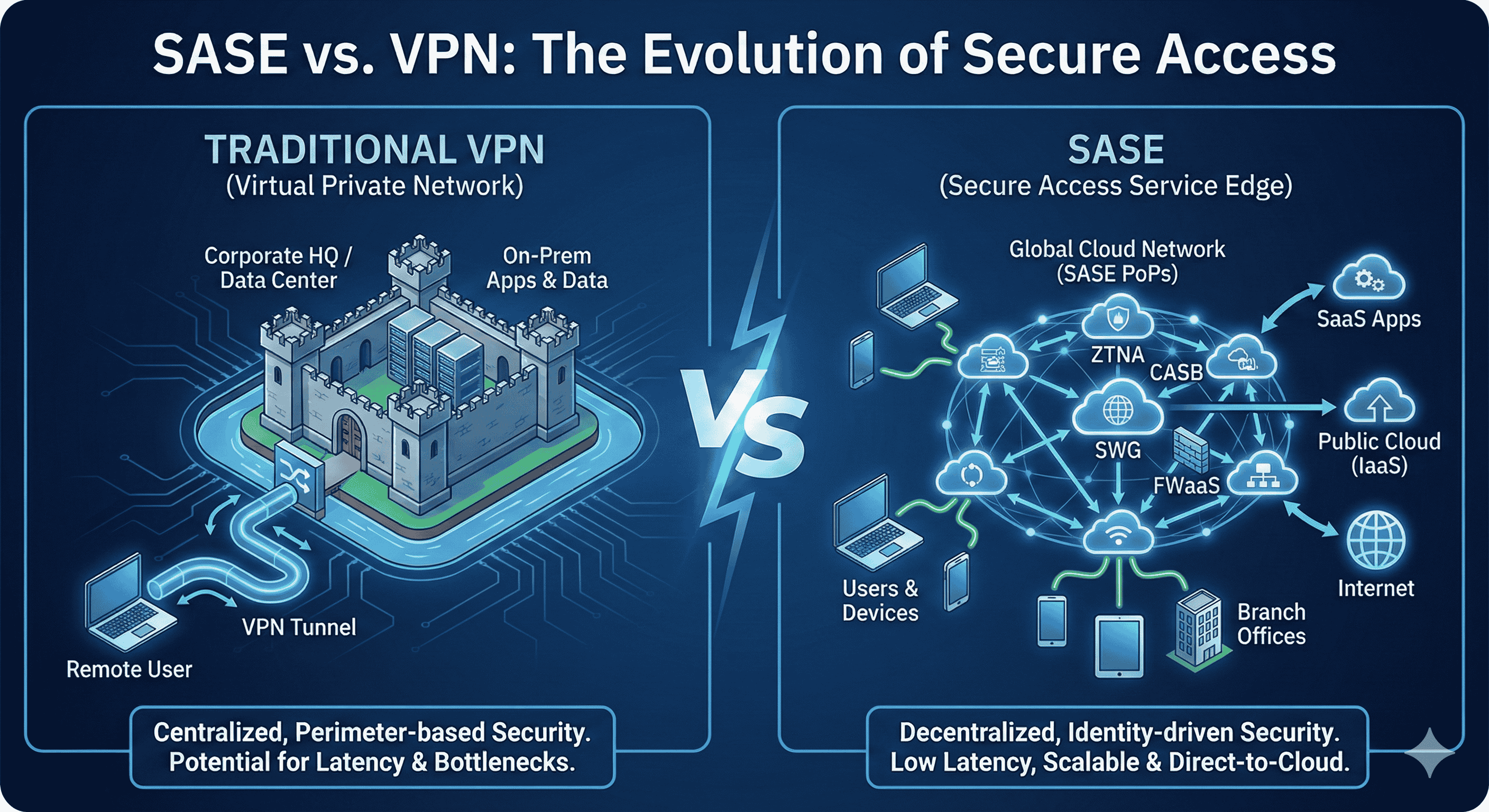
SASE and VPN both connect users to company resources, but the difference lies in how they secure traffic, apply access rules, and maintain performance. VPN sends traffic through a central tunnel. SASE pushes security to the nearest cloud edge, inspects threats in transit, and applies identity-based access instead of broad network trust.
Real Advantages and Disadvantages of SASE vs VPN
VPN advantages
Easy to deploy for very small teams
Works for old internal apps that don’t need internet exposure
Cheap only when scale is limited
Suitable for short-term or restricted access users
VPN disadvantages
Becomes slow when users increase
No built-in threat inspection
Flat trust increases lateral movement risk
Needs hardware upgrades for scale
IP-based rules don’t adapt to device health or user behavior
Higher long-term IT workload
SASE advantages
Fast access using global edge locations
Identity + device-based access control
Inspects threats using cloud firewalls, SWG, CASB, and ZTNA together
Stops lateral movement with segmentation
No hardware dependency for user scale
One dashboard for visibility and compliance
Lower IT workload
SASE disadvantages
Needs planning for legacy internal-only apps
Not ideal for ultra-small teams that don’t use cloud or SaaS
Works best when security rules are mapped clearly
Latency Reality (VPN vs SASE)
Why VPN is slower
All traffic goes to one central VPN concentrator
Uses public internet tunnels
No smart traffic routing
Shared tunnel congestion
Why SASE is faster
Traffic goes to the closest cloud edge
Uses optimized routing paths
Security is enforced locally, not centrally
A secure remote access stack must include identity-based access, cloud firewall inspection, and traffic routing that stays fast under scale.
See how NetNXT delivers SASE and firewall management for distributed enterprises.
What impacts the cost difference for enterprises?
VPN needs hardware, throughput upgrades, certificates, client licenses, and add-on tools like SWG or CASB separately
SASE consolidates multiple security controls into one subscription model
VPN IT manpower cost increases as users grow
SASE reduces manual IT effort by automating rule and security updates
How Security Heads choose the best remote access security for business under SASE
Security Heads prioritize:
Identity-based access, not open network reach
Cloud firewalls that inspect encrypted traffic
Segmentation that limits breach spread
Performance that stays fast
Compliance dashboards that show real visibility
If your business is facing slow remote access, poor visibility, or growing network risk, your remote access layer needs inspection, identity-based policies, and cloud-native routing.
NetNXT provides this through managed SOC, MDR, and SASE security services.
FAQ
1) What is SASE vs VPN remote access security comparison?
It compares how users connect and how traffic is secured. VPN transports data through central tunnels without inspection. SASE enforces identity-based access, inspects threats at cloud edges, and protects offices, cloud apps, and remote teams in one stack.
2) What are SASE vs VPN advantages and disadvantages?
VPN is easy and cheap for small teams but slow at scale, lacks inspection, and increases lateral movement risk. SASE is faster, identity-driven, inspects threats, reduces IT overhead, but needs planning for legacy internal-only apps.
3) Which is the most secure remote access option under SASE?
SASE combined with ZTNA is the most secure remote access option. It allows access per app, validates device health continuously, inspects encrypted traffic using cloud firewalls, and prevents network-wide pivoting.
4) How does SASE perform better for remote SaaS access?
SASE routes traffic to the closest cloud edge, applies identity-based access, and uses optimized routing paths. It inspects threats locally using FWaaS, SWG, and CASB, removing central tunnel choke points that slow VPNs.
5) How do Security Heads evaluate best remote access security for business SASE?
They check identity-based access, encrypted traffic inspection, segmentation depth, latency impact, compliance visibility, automation of security updates, and whether the provider delivers firewall management service through an MSSP or SOC-backed model.