
SASE Architecture Blueprint for Indian Enterprises
Indian enterprises in 2025 operate across 20–150+ branches, cloud workloads, remote employees, IoT devices, and SaaS applications—yet most still rely on fragmented security tools, aging VPNs, and inconsistent firewall policies. This has created huge gaps in performance, visibility, compliance, and breach containment.
Secure Access Service Edge (SASE) solves this by converging networking + security into one cloud-native architecture—built around identity, Zero Trust access, and globally distributed inspection points.
This blueprint gives Security Heads, IT Infrastructure Managers, and Network Leaders a clear, executable SASE architecture model for India in 2025—covering design, components, migration, vendors, pricing, and real use cases.
Why Indian Enterprises Are Moving to SASE in 2025
Enterprise networks in India are under structural stress.
1. Fragmented Multi-Site Networks (20–150+ branches)
Each branch uses different firewalls, policies, and internet circuits
Security visibility is inconsistent and delayed
Troubleshooting takes days, not minutes
2. High MPLS Cost vs Poor Performance
MPLS still costs 3–6x more than broadband
Yet cloud and SaaS traffic still backhauls to DC → massive latency
3. Remote Workforce Security Pressure
VPN licensing saturation
No device posture checks
No continuous authentication
4. VPN Instability at Scale
At 500–5,000 users:
Tunnel congestion
Authentication failures
No lateral movement control
Also Read: SASE vs VPN 2025: Cost, Security & Performance Comparison for Security Heads
5. Compliance Push (ISO, RBI, CERT-In)
Centralized logging
Audit-ready access records
Data movement visibility now mandatory
6. Shadow IT Explosion
SaaS, AI tools, unmanaged cloud apps
No inspection → silent data leakage
SASE solves all six problems through one unified architecture.
Core Components of a True SASE Stack
A real SASE platform is not just SD-WAN + VPN in the cloud.
It is a 7-layer converged security + networking fabric.
1. SD-WAN as the Transport Layer
Provides:
Dynamic traffic steering
MPLS + broadband + LTE aggregation
Application-aware routing
SLA enforcement
This becomes the traffic engine underneath SASE.
Also Read: Migrating from SD-WAN to SASE: A 90-Day Playbook for IT Infra Managers
2. FWaaS (Firewall-as-a-Service)
Cloud-delivered L3–L7 firewall
IPS/IDS, malware inspection
Identity-based policy enforcement
Branch firewall replacement
Also Read: FWaaS Providers Compared: Which Cloud-Native Firewall Fits Multi-Site India?
3. Secure Web Gateway (SWG)
URL filtering
SSL inspection
Threat prevention for web traffic
Shadow IT detection
4. CASB / SaaS Access Controls
SaaS activity monitoring
Risk-based app access
Inline data inspection
API-based compliance visibility
5. Zero Trust Network Access (ZTNA)
App-level access (not network-level)
No lateral movement
Identity + device + context-based control
6. Data Protection (DLP / Inline Controls)
Prevents sensitive data exfiltration
Enforces RBI, ISO, GDPR, SOC policies
Works inline across cloud + web + email
7. Identity Integration (MFA, SSO, Device Trust)
Azure AD, Okta, JumpCloud integration
Conditional access
Device posture enforcement
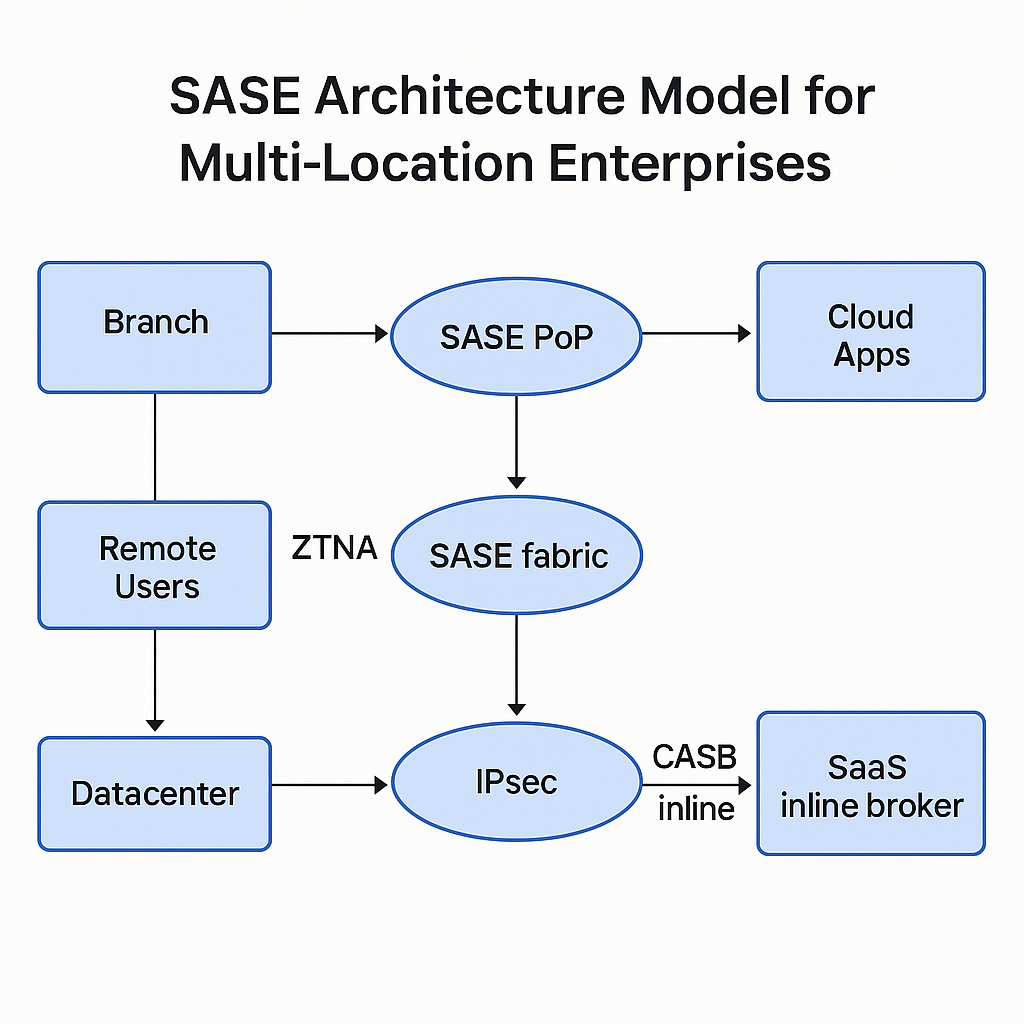
SASE vs VPN: Security and Latency
Why VPN Fails at 500–5000 Users
Flat trust inside tunnel
No microsegmentation
Centralized choke point
High breach blast radius
SASE Advantages
Zero lateral movement
Nearest PoP routing
Inline inspection
Identity-based segmentation
SD-WAN to SASE Migration Framework (90 Days)
Phase 1 — Baseline Audit
Users, apps, branches
Traffic flows
Risk hotspots
Phase 2 — Identity + Device Trust
IdP integration
MFA rollout
Device posture checks
Phase 3 — WAN + ZTNA Rollout
Branch traffic steering
App-level access replacement for VPN
Phase 4 — FWaaS + SWG Consolidation
Remove legacy firewalls
Enable inline inspection
Choosing a SASE Vendor: Evaluation Matrix (2025)
Cato Networks
Best unified backbone + SASE stack
Strong India performance
Ideal for global multi-site enterprises
Zscaler
Strong SWG + CASB
Best for SaaS-first organizations
Palo Alto Prisma
Threat intelligence depth
Expensive, complex deployments
Twingate (ZTNA Only)
Zero Trust access replacement for VPN
Not full SASE
Cisco Meraki + Cisco Umbrella
Good for Cisco-heavy networks
Weaker full-stack SASE convergence
Real Use Cases From Indian Enterprises
1. Multi-Site Retail
100+ stores
Unified firewall + internet breakout
PCI-DSS compliance via SASE
2. BFSI
RBI audit-ready logging
Identity-first access to core banking
Zero Trust remote employees
3. Manufacturing
OT/IT isolation
Secure vendor access
Threat containment at machine level
4. IT/ITES Distributed Workforce
Cloud-first security
No VPN overload
Identity-bound access to client systems
Common Pitfalls in SASE Deployments (and How to Avoid Them)
Pitfall | Impact | Fix |
|---|---|---|
Identity not integrated | Policy failure | Integrate before rollout |
Poor PoP selection | Latency issues | Choose city-nearest PoPs |
Misconfigured Zero Trust | Access outages | Phased ZTNA rollout |
Cloud routing errors | SaaS slowness | Test breakout paths |
SD-WAN left unmanaged | Traffic chaos | Central orchestration |
FAQ
1) What is a SASE Architecture?
SASE is a cloud-delivered architecture that converges SD-WAN, FWaaS, SWG, CASB, DLP, and ZTNA into one identity-driven security fabric.
2) Is SASE Better Than VPN for 2025?
Yes. SASE removes VPN choke points, eliminates lateral movement, lowers latency, and reduces security stack cost by 35–55%.
3) What Is the Difference Between SD-WAN and SASE?
SD-WAN optimizes transport. SASE delivers transport + full security through one cloud-native platform.
4) How Long Does a SASE Migration Take?
Typically 60–120 days for most Indian enterprises with 10–100 branches.
5) How Many PoPs Are Required for India?
Minimum 4–6 PoPs across Mumbai, Chennai, Hyderabad, Bengaluru, and Delhi NCR.