
Fertility and Reproductive Medicine Industry
Healthcare
Strengthening Network Security for a Leading Fertility & Reproductive Medicine Provider

The fertility and reproductive medicine industry has transformed rapidly over the last decade. Clinics today operate as hybrid digital-clinical environments, handling highly sensitive patient data, lab systems, IoT devices, teleconsultation platforms, and multiple internal networks across branches. This industry faces some of the most stringent compliance and cybersecurity expectations due to the involvement of PHI (Protected Health Information), embryo storage records, genetic data, treatment outcomes, and sensitive patient communication logs.
The client, a multi-location fertility and reproductive medicine brand, approached us with significant operational and cybersecurity challenges. Their digital dependence had grown faster than their security maturity, creating gaps that exposed them to risk.
Key Challenges Identified
Fragmented Network & Security Stack: The clinic operated multiple branches and labs with varying network configurations, outdated firewalls, and no centralized security visibility. This created blind spots and inconsistent enforcement across locations.
High Exposure to Ransomware & Data Theft: Healthcare, especially fertility centers, has become a prime cyberattack target because PHI and genetic/fertility data fetch a high price on underground markets. The client had already experienced multiple intrusion attempts.
Unsecured Lab Devices & IoT Systems: Embryology lab equipment, cryo-storage monitoring systems, smart lab tools, and imaging devices were connected but lacked proper segmentation and security monitoring.
Growing Digital Footprint: Online patient portals, teleconsultations, EMR access, WhatsApp-based communication, and cloud-based scheduling tools increased the surface area vulnerable to attack.
Regulatory and Compliance Pressure: The clinic needed to align with:
Digital Personal Data Protection Act (DPDP) India
Healthcare data retention guidelines
HIPAA-equivalent security practices (for international patients)
No 24/7 Monitoring or Incident Response: Internal IT teams were small and focused on operations, not continuous threat monitoring, log analysis, or response.
The Solution: NetNXT’s Managed Network Security Service
To support the client’s growth and secure their clinical and digital ecosystem, NetNXT deployed a fully managed, end-to-end Managed Network Security Service tailored for healthcare and multi-location operations.
Key Elements Implemented
a) Unified Network Security Architecture
We redesigned the entire network security posture:
Centralized firewall management across all branches
Standardized security policies
Zero Trust principles for sensitive systems
Segmentation of OT (lab devices), IT systems, and guest networks
This eliminated inconsistencies and created a predictable, controlled environment.
b) Continuous Threat Monitoring & SOC Operations
A 24/7 managed SOC layer was added to:
Detect suspicious events early
Monitor patient data access anomalies
Identify ransomware behaviors
Track east–west movement inside the network
Every incident generated actionable alerts and immediate responses.
c) Enforced Data Protection Controls
We implemented strict controls for:
Patient data access
EMR application traffic
Secure communication channels
Encrypted backups and retention
This protected PHI and ensured compliance alignment.
d) Robust Perimeter & Internal Defense
We strengthened both external and internal defenses with:
Advanced intrusion prevention
Web filtering for clinical staff
Email threat detection
Device control policies
This helped control infection vectors that commonly affect healthcare environments.
e) Performance & Operational Optimization
Branch-to-branch communication, EMR access, and teleconsultation workflows were optimized for:
High availability
Lower latency
Minimal downtime
This improved clinician experience and patient service quality.
Impact & Results
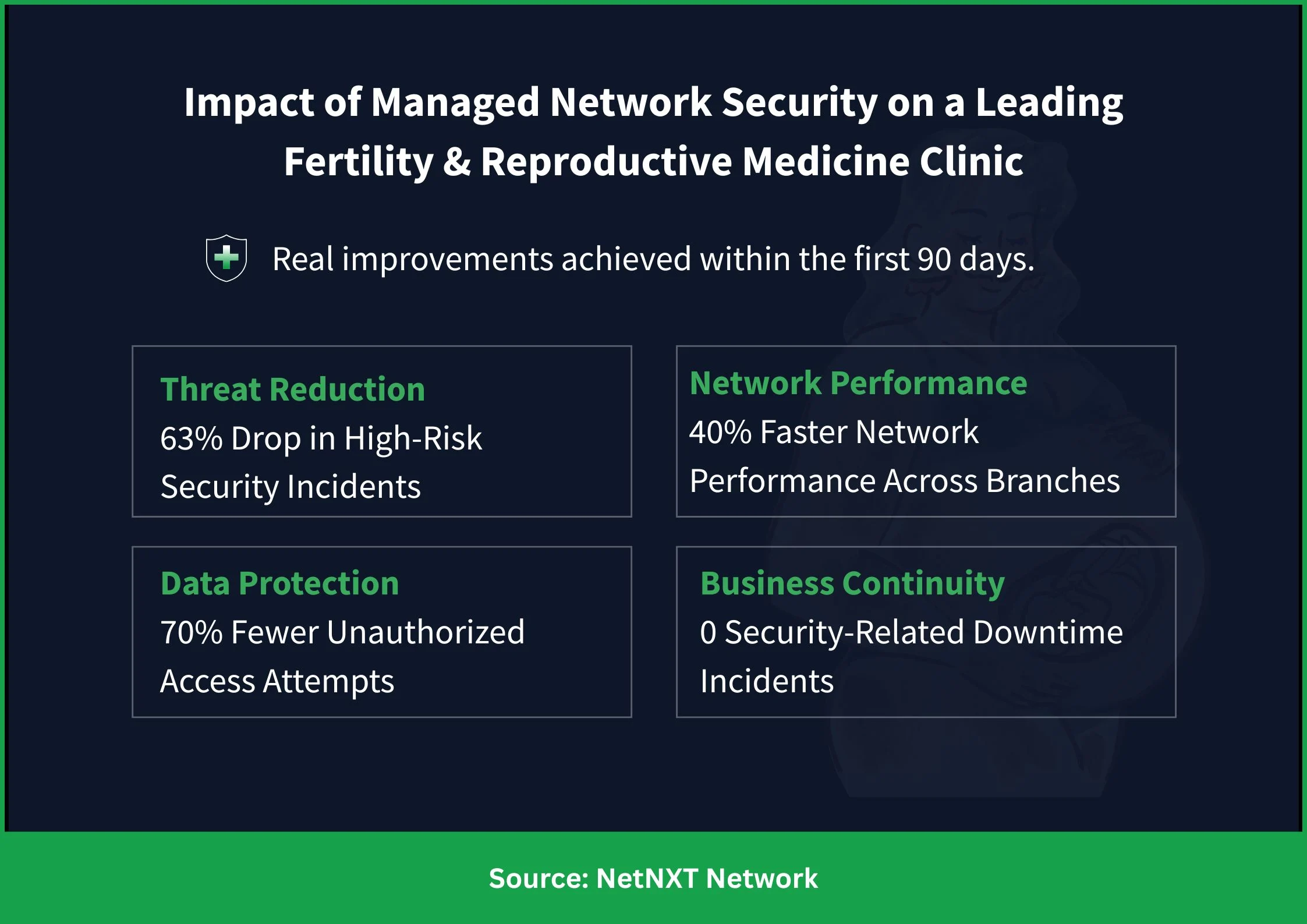
Within the first 90 days, significant improvements were seen across security maturity, operational efficiency, and data protection.
Measured Outcomes
63% reduction in high-risk security incidents due to real-time monitoring and uniform policies.
40% improvement in network performance across branches, positively impacting EMR speed and teleconsultations.
Zero downtime incidents related to security events post implementation.
Full compliance alignment with DPDP expectations and global healthcare security best practices.
Near 70% decrease in unauthorized internal access attempts because of segmentation and Zero Trust controls.
Enhanced clinician productivity, thanks to stabilized network operations and predictable access.
Improved patient trust due to secure digital interactions and consistent communication channels.
The transformation brought the clinic from a fragmented, high-risk environment to a stable, continuously protected, and scalable network infrastructure.
Summary
The fertility and reproductive medicine space requires extremely high levels of security maturity due to the sensitivity of data and operational reliance on digital systems. NetNXT’s Managed Network Security Service helped this client establish a robust foundation, delivering consistent protection, improved performance, and full visibility across all branches and lab environments.
If your healthcare or clinical organization is scaling operations, adopting telemedicine, or modernizing patient experience, NetNXT can help establish a secure, future-ready network environment without adding operational burden to your internal teams.
Contact Today .