
How to Implement Zero Trust Security in Banking: The RBI-Aligned Guide for Indian Banks
Perimeter Security Is Dead. Indian Banks Are Still Running On It.
India lost over ₹23,000 crore to financial cyber fraud in 2025. BFSI cyberattacks surged 25% year-on-year. At the Business Standard BFSI Insight Summit 2025, security leaders reached a unanimous conclusion: Zero Trust is no longer a best practice for Indian banks — it is a survival requirement.
The old model — trust everything inside the network, block everything outside — collapsed the moment banks went hybrid, cloud-first, and third-party dependent. Attackers don't breach perimeters anymore. They walk in through compromised credentials, vendor access, and misconfigured cloud workloads.
The fix is Zero Trust. And now the RBI has made it an expectation.
What Is Zero Trust Security for Banks?
Zero Trust is a security model built on one principle: never trust, always verify — regardless of whether a user, device, or application is inside or outside your network.
In banking, this means:
No user gets access by default — every access request is verified against identity, device health, location, and behaviour
Employees, vendors, and third-party integrations operate under least-privilege — they access only what their role requires, nothing more
The network is segmented so a breach in one zone cannot spread laterally to core banking systems or payment infrastructure
Every session is continuously monitored, not just authenticated at login
This is the architecture the RBI is now pushing Indian banks toward — and what separates institutions that contain breaches in minutes from those that go offline for days.
RBI Zero Trust Mandate: What Indian Banks Must Know
In its June 2025 Financial Stability Report, the Reserve Bank of India explicitly identified Zero Trust Architecture as a foundational pillar of cyber resilience for regulated entities. This was a direct response to the ₹23,000 crore lost to financial fraud and a 42% surge in reported cybercrimes in 2025.
What the RBI framework now requires, aligned with Zero Trust principles:
Identity-first access: MFA with biometrics mandated under 2025 Payment Directions — core Zero Trust requirement
Continuous monitoring: CART (Cyber Attack Readiness and Testing) exercises requiring real-time threat hunting capability
Third-party access controls: Vendors must be verified, segmented, and logged — the exact problem ZTNA solves
Sub-15-minute incident response: Achievable only with automated Zero Trust policy enforcement via SOAR
Audit-ready access logs: Every access event logged for CERT-In mandated reporting
RBI's Annual Report for FY 2024–25 recorded 353 penalties totalling ₹54.78 crore for non-compliance across regulated entities. The financial and reputational cost of falling behind on Zero Trust implementation is now quantifiable.
🔗 Related: Top 10 Cybersecurity Threats Facing Banks in 2026 — And How to Stop Them
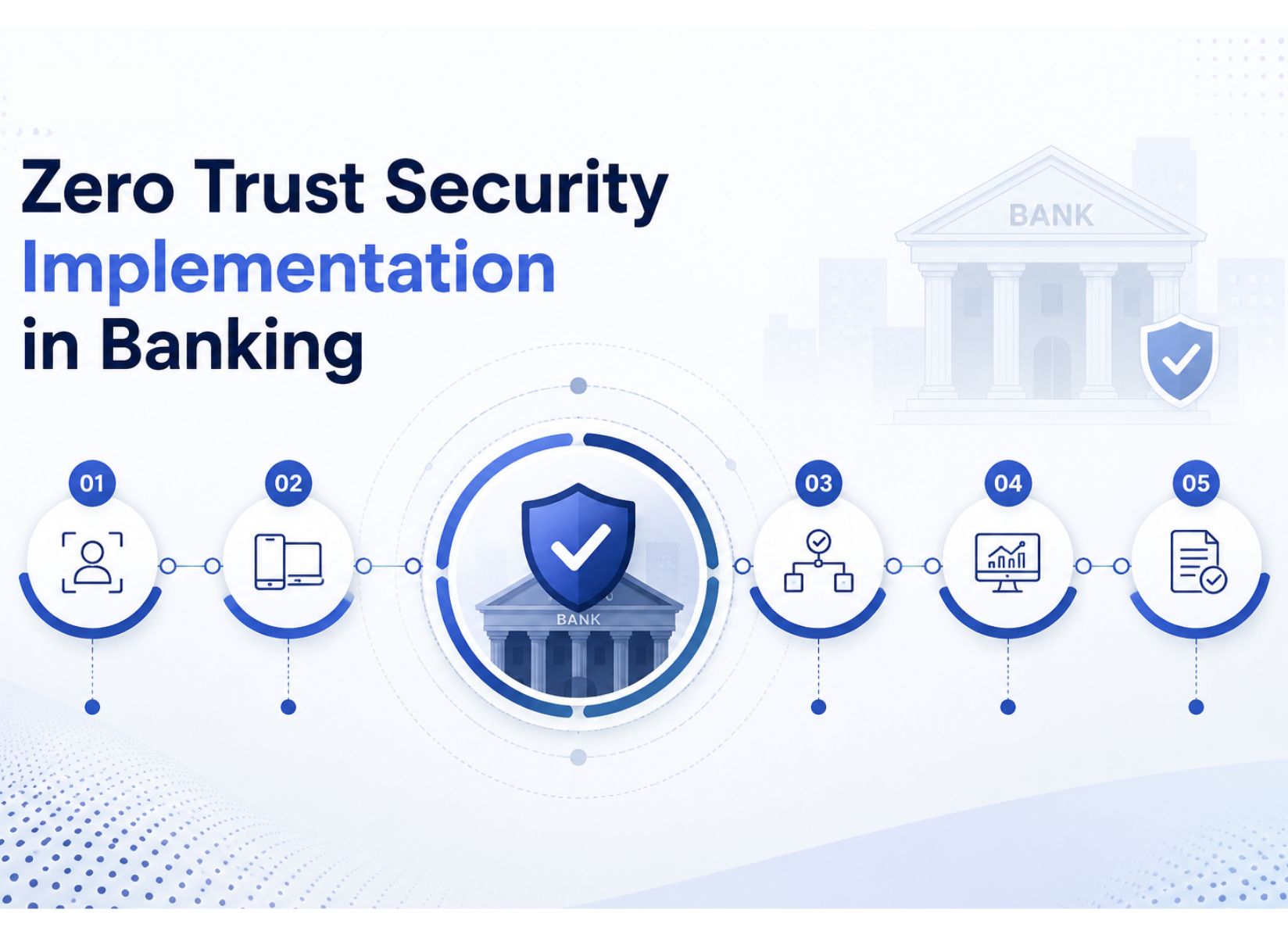
Zero Trust Architecture for Banks: The 5 Core Pillars
Before implementation, understand what Zero Trust actually covers in a banking environment:
Identity — Every user, service account, and API must be authenticated continuously. MFA, SSO, and Privileged Access Management are the foundation
Devices — Every endpoint accessing banking systems must meet a defined security posture — patch level, encryption status, EDR presence — before access is granted
Network — Microsegmentation divides the environment into isolated zones: core banking, APIs, third-party integrations, and payment systems cannot communicate freely
Applications — Access is granted per application, not per network. Shadow IT and unauthorised SaaS are discovered and controlled
Data — Sensitive customer and transaction data is encrypted at rest and in transit, with DLP controls preventing unauthorised exfiltration
How to Implement Zero Trust Security in Banking: Phase-by-Phase Roadmap
Zero Trust is not a product — it is an architecture built in phases. Here is a practical roadmap aligned to RBI requirements:
Phase 1 — Assess and Define (Weeks 1–4)
Conduct a gap analysis against RBI's cyber resilience framework using CERT-In empanelled auditors
Map all users, devices, data flows, third-party access paths, and trust assumptions across your environment
Identify your protect surface: core banking applications, payment gateways, customer data stores, and privileged admin systems
Phase 2 — Identity First (Weeks 4–10)
Deploy unified Identity and Access Management (IAM) covering workforce, machine identities, and API credentials
Enforce MFA across all access points — remote, branch, and cloud
Implement Privileged Access Management (PAM) with credential vaulting, session recording, and just-in-time access for high-privilege roles
Eliminate shared accounts and static credentials entirely
This is the highest-ROI phase. Identity controls alone close the most common banking breach vectors.
Phase 3 — Network Segmentation and ZTNA (Weeks 10–20)
Replace or augment legacy VPNs with Zero Trust Network Access (ZTNA) — vendors and remote users access only specific applications, never the full network
Implement microsegmentation across core banking, payment systems, cloud workloads, and third-party integration zones
Enforce deny-by-default policies — if a connection is not explicitly authorised, it is blocked
Phase 4 — Continuous Monitoring and Enforcement (Ongoing)
Deploy AI-SIEM with UEBA for real-time behavioural monitoring across all access events
Implement SOAR for automated policy enforcement and sub-15-minute incident response playbooks aligned to RBI requirements
Conduct quarterly Zero Trust posture reviews and simulate breach scenarios across segment boundaries
Ready to Build Zero Trust Architecture for Your Bank?
Most banks know Zero Trust is necessary. Few know where to start without disrupting operations. NetNXT's security team maps your current environment, identifies the fastest path to RBI-aligned Zero Trust, and implements it in phases — with no operational disruption.
Get Your Zero Trust Readiness Assessment →
How NetNXT Implements Zero Trust for Indian Banks
NetNXT is India's trusted MSSP with 11+ years of experience and 500+ enterprise clients. Our Zero Trust implementation stack for banking is built around proven, RBI-compliant technology:
JumpCloud IAM and PAM — Identity-first access with MFA enforcement, SSO, credential vaulting, and least-privilege controls across all users and devices
Twingate ZTNA — Application-level access that replaces VPNs, segments third-party vendor access, and enforces device posture checks before every session
Cato Networks SASE — Converged Zero Trust network security across all branches, remote users, and cloud workloads — consistent policy, single pane of glass
SentinelOne XDR — Device posture enforcement and continuous endpoint monitoring as the device pillar of Zero Trust
AI-SIEM with UEBA — Continuous behavioural monitoring that detects anomalous access patterns and triggers automated response within RBI's mandated response windows
Scrut Compliance Automation — Maps Zero Trust controls to RBI, PCI DSS, and ISO 27001 frameworks continuously — so you're always audit-ready
🔗 See how NetNXT secured a logistics enterprise with Zero Trust: Zero Trust Security for Logistics and Supply Chain — Case Study 🔗 Related: Zero Trust Integration with SASE for Enterprise Security
Conclusion
Zero Trust is not a technology upgrade. It is a fundamental rethinking of how banks grant access, monitor behaviour, and contain threats. With the RBI's June 2025 Financial Stability Report placing it at the centre of cyber resilience expectations — and ₹23,000 crore lost to financial fraud in 2025 — the question is no longer whether Indian banks should implement Zero Trust.
The question is how fast they can get there before the next breach decides it for them.
Talk to NetNXT's Zero Trust Banking Specialists →
FAQs
1) What is Zero Trust security for banks and why does it matter in 2026?
Zero Trust is a security model that requires continuous verification of every user, device, and application before granting access — regardless of network location. For banks, it matters because perimeter-based security fails completely against insider threats, compromised credentials, and third-party supply chain attacks — the three most common breach vectors in Indian BFSI in 2025.
2) Has the RBI mandated Zero Trust for Indian banks?
The RBI's June 2025 Financial Stability Report explicitly identified Zero Trust Architecture as a foundational pillar of cyber resilience for regulated entities. While not yet a hard legislative mandate, RBI's supervisory expectations, CART exercises, and continuous monitoring requirements effectively make Zero Trust implementation necessary for compliance — and the 353 penalties issued in FY 2024–25 demonstrate the cost of falling short.
3) What is the difference between ZTNA and a traditional VPN for banking?
A traditional VPN grants users access to the entire network once authenticated — creating massive lateral movement risk if credentials are compromised. ZTNA grants access only to specific applications, verified per session against identity and device posture. For banks with third-party vendors and remote workforces, ZTNA eliminates the over-permissive access that VPNs create and that ransomware and insider threats exploit.
4) How long does Zero Trust implementation take for a bank?
A phased implementation typically spans 5–6 months: 4 weeks for assessment and gap analysis, 6 weeks for identity and PAM deployment, and 10 weeks for ZTNA, microsegmentation, and continuous monitoring rollout. The timeline depends on legacy infrastructure complexity, but starting with identity controls delivers the highest security ROI fastest and aligns immediately with RBI's MFA and access control requirements.
5) Which Zero Trust solutions are best suited for Indian banks?
For Indian banks, the most effective Zero Trust stack combines JumpCloud for IAM and PAM, Twingate for ZTNA and third-party access control, Cato Networks for SASE-based network Zero Trust, SentinelOne for device posture and endpoint protection, and an AI-SIEM for continuous behavioural monitoring. NetNXT deploys and manages this stack end-to-end, aligned to RBI's cybersecurity framework.