
Logistic and Supply Chain Industry
Logistics and Supply Chain
Securing a Distributed Logistics & Supply Chain Network with Zero Trust (Powered by Twingate)
The logistics and supply chain industry runs on real-time coordination between warehouses, fleets, distribution hubs, and field teams. As operations expand, digital systems, warehouse management platforms, GPS trackers, handheld scanners, ERP systems, and cloud applications become the backbone of daily activity. But the same connectivity also opens the door to cyber risks.
Our client, a large logistics operator managing nationwide inventory movement and last-mile delivery, was facing increasing security pressure. Their operations were spread across multiple warehouses, on-road fleets, third-party depots, and remote staff. This created a wide attack surface that traditional VPNs and perimeter firewalls simply couldn’t control anymore.
They needed a Zero Trust model that secures access based on identity, device posture, and context—not location.
And to enable this without slowing operations, we chose Twingate, a modern ZTNA platform designed for distributed, high-mobility environments.
Key Challenges Identified
Over-dependence on VPNs & Legacy Access Control: VPN overcrowding led to latency issues, frequent disconnections, and exposed internal networks once users were authenticated.
High Lateral Movement Risk Across Warehouses: Once an attacker entered the network, they could theoretically access scanning systems, warehouse servers, and logistics apps due to flat network topology.
Remote Workforce & On-Road Access Gaps: Fleet supervisors, warehouse managers, and field teams used unsecured networks—cafés, depots, personal hotspots—creating unpredictable risk.
Poor Visibility Over Connected Devices: Scanners, handheld terminals, contractor laptops, and IoT sensors had inconsistent controls and no centralized oversight.
Third-Party Vendors Accessing Core Systems: Vendors connecting to ERP, inventory, or transport systems created vulnerabilities due to weak access segregation.
Operational Downtime Due to Unstable Access: Slow VPN performance directly affected scanning accuracy, dispatch timing, and warehouse throughput.
The company needed a modern, identity-first access approach that supports mobility without exposing internal systems.
NetNXT’s Zero Trust Implementation Powered by Twingate
We deployed a full Zero Trust architecture across their distributed logistics network using Twingate as the core ZTNA stack.
a) Identity-Based Access Control
Access was restructured so that users, contractors, and automated systems could only reach the specific resources assigned to them. No broad network access. No shared credentials.
b) Complete Network Segmentation Across Warehouses
We isolated:
Warehouse management systems
IoT scanners and handheld terminals
ERP servers
Vendor portals
Administrative networks
This ensured that even if a breach occurred, it couldn’t move horizontally.
c) Twingate for Secure, Fast Remote Access
We replaced their legacy VPN with Twingate, enabling:
Fast, encrypted access
Zero exposure of internal IPs
Resource-based permissions
Improved stability for field & warehouse staff
This eliminated bottlenecks during peak dispatch hours.
d) Device-Posture-Based Security
Only trusted, updated, and compliant devices including scanners and laptops could connect. Unknown devices were automatically blocked.
e) Logging, Monitoring & Conditional Access
Every access attempt was logged with:
Identity
Device type
Location
Time
Resource requested
Suspicious patterns were automatically flagged.
f) Vendor & Contractor Access Hardening
Each vendor received isolated access channels with:
No network-wide permissions
Contextual restrictions
Strict time-bound access
This closed a major attack vector.
The Impact
Within 60 days of deploying Zero Trust with Twingate, the logistics operator transformed both security and operational efficiency.
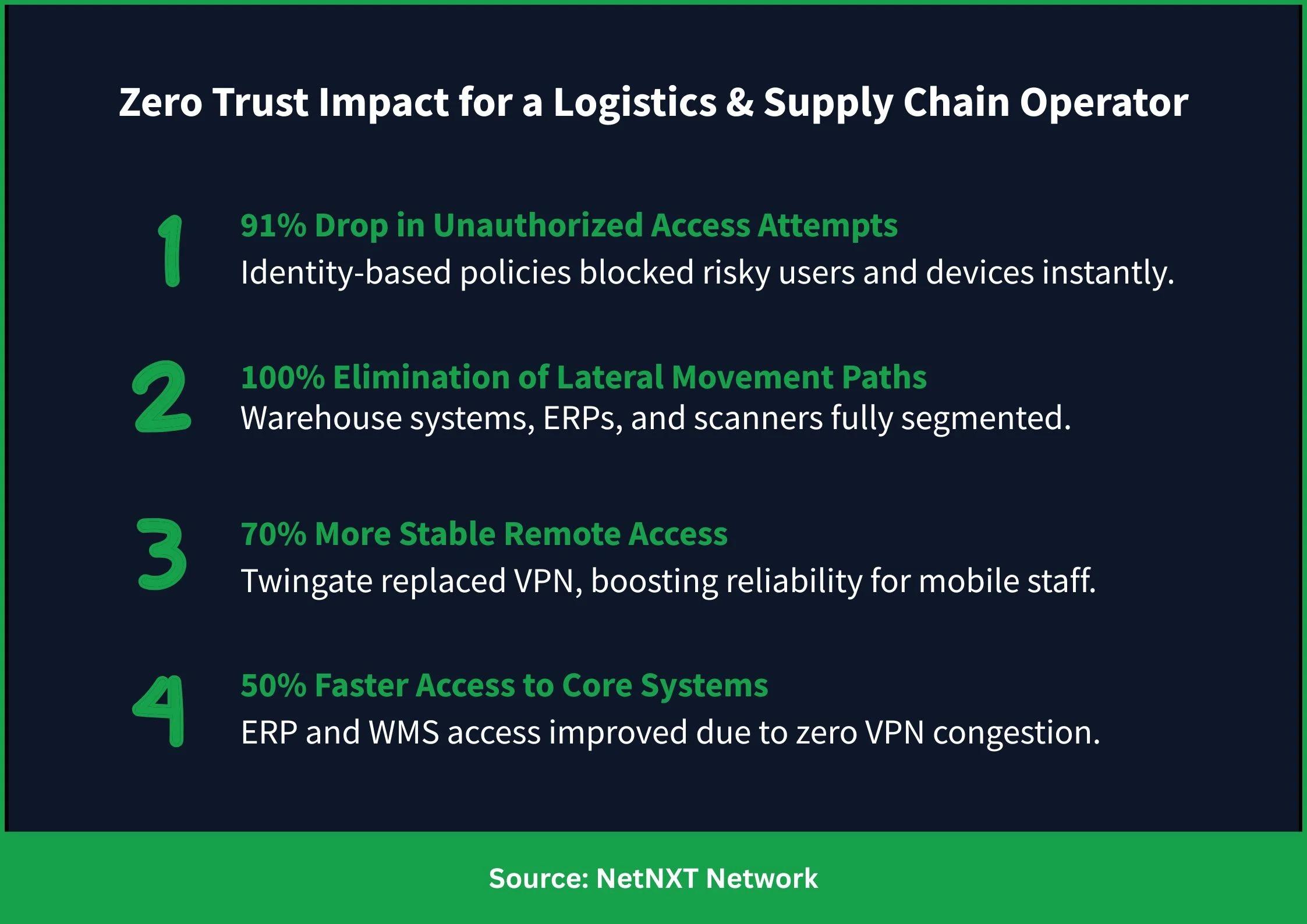
Measured Outcomes
91% reduction in unauthorized network access attempts.
100% elimination of lateral movement paths across warehouses and distribution centers.
70% increase in remote access stability for field teams and dispatch managers.
Near 50% faster access to ERP, WMS, and scanning systems due to removal of VPN bottlenecks.
95% reduction in exposed internal IPs dramatically lowering attack surface.
Improved vendor accountability, with complete access visibility and time-bound controls.
Zero disruptions in warehouse operations during peak hours post-implementation.
Security became stronger, access became smoother, and operations ran more predictably exactly what a logistics network needs.
Conclusion
Logistics and supply chain operations live and die by speed, reliability, and coordination. Zero Trust is no longer an advanced concept for this industry it’s a necessity. With Twingate’s modern ZTNA and NetNXT’s implementation framework, this company now runs a secure, scalable, and high-performance access environment across warehouses, fleets, and remote teams.
If your logistics operation deals with distributed teams, third-party access, or legacy VPN bottlenecks, NetNXT can help you move to a Zero Trust model that protects your network without slowing down your business.