
Zero Trust and SASE: Architecture for Multi-Location Enterprises
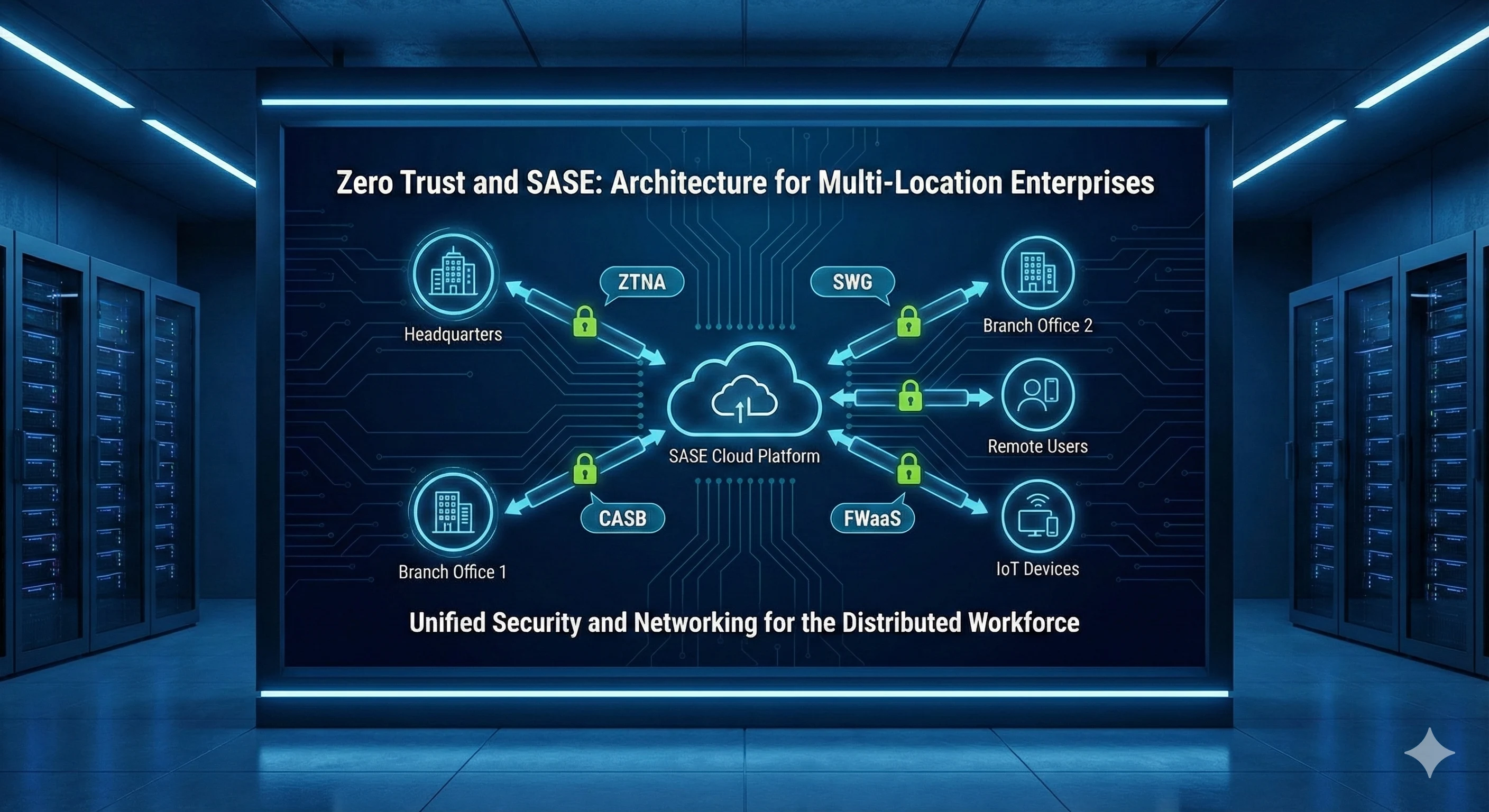
Multi-location enterprises across India are facing the same problem: users, devices, applications, and workloads now live everywhere—branches, warehouses, remote offices, factories, cloud, and SaaS platforms. Traditional firewall-perimeter models can’t protect this environment, and SD-WAN alone can’t authenticate identity, evaluate device health, or enforce continuous trust.
This is why modern IT and Security leaders are combining Zero Trust (identity-first) and SASE (network-first) to build a unified, branch-aware, cloud-ready security fabric.
This guide explains how the combined architecture works, how identity providers integrate, how device trust is enforced, and how inline inspection strengthens security in distributed environments.
1. Zero Trust: The Identity-First Foundation
Zero Trust replaces the traditional “trust once” model with continuous verification.
Core Principles
Never trust, always verify
Validate identity + device + context
Apply least-privilege access
Enforce per-application segmentation
Risk-based access decisions every time a connection is made
Key Zero Trust Components
Identity provider (IdP)
MFA & conditional access
Device compliance engine
Micro-segmentation
Continuous authentication
Per-app traffic isolation
Why Zero Trust is critical for multi-location enterprises
Branch traffic behaves inconsistently
Remote employees bypass perimeter controls
Contract/temporary staff need restricted access
OT/ICS devices require strict segmentation
Zero Trust ensures no user or device gains blanket access—even if they connect from trusted networks.
2. SASE: The Network-First Delivery Layer
Zero Trust defines who can access.
SASE defines how access is securely delivered across the network.
What SASE provides
Global policy enforcement
Distributed PoP-based inspection
Unified SWG + CASB + FWaaS
Optimized routing for SaaS and cloud
SD-WAN + ZTNA + DLP integrated
Lower latency for multi-branch environments
Why SASE matters in multi-location setups
Branches need consistent security, not appliance sprawl
Traditional hub-and-spoke limits performance
Security teams need unified visibility across sites
Cloud workloads require distributed inspection
Zero Trust policies must follow the user/device everywhere
The SASE impact
Predictable performance
Elastic scaling across branches
Centralized policies
Zero maintenance appliances
Also Read: SASE Architecture Blueprint for Indian Enterprises (2025)
3. Why Zero Trust and SASE Must Be Combined
Trying to deploy Zero Trust without a network delivery layer results in policy fragmentation, while using SASE without Zero Trust results in broad access surfaces.
What Zero Trust solves
Identity authentication
Device posture
Per-app microsegmentation
Access policies
What SASE solves
Traffic routing
Inline inspection
Threat prevention
Scalability
Consistent global enforcement
Combined outcomes
Challenge | Zero Trust Alone | SASE Alone | Combined |
|---|---|---|---|
Identity security | Strong | Weak | Strong |
Network performance | Weak | Strong | Strong |
App-level segmentation | Strong | Medium | Strong |
Inline inspection | Weak | Strong | Strong |
Multi-site consistency | Weak | Strong | Strong |
Lateral movement control | Medium | Medium | Strong |
Device posture enforcement | Strong | Weak | Strong |
This is the modern security architecture:
Zero Trust decides who gets access → SASE decides how access is delivered.
4. Identity Provider Integrations (Okta, JumpCloud, Azure AD)
Identity is core to Zero Trust—and it must seamlessly bind into the SASE fabric.
4.1 Azure AD (Entra ID)
Largest adoption in Indian enterprises
Strong conditional access engine
Built-in MDM/UEM integration
4.2 Okta
Strongest identity federation
Best for multi-cloud and complex app environments
4.3 JumpCloud
Emerging strong player for mid-sized enterprises
Unified directory + MDM + device trust in one platform
Cost-effective for distributed teams
How identity integrates with SASE
SSO maps user identity directly into network policies
Risk score influences access decisions
Identity-based segmentation replaces VLANs
MFA enforced before routing traffic
Outcome
Users, apps, and devices gain dynamic, real-time access control regardless of location.
Also Read: JumpCloud Partners: Enterprise Integration Guide
5. Device Trust Enforcement (The Missing Layer in Traditional Networks)
Multi-location enterprises have mixed device environments:
Managed laptops
BYOD devices
Tablets and handhelds
OT/IoT equipment
Shared terminals
Device trust ensures only healthy, compliant devices can connect.
Key device trust checks
OS version
Patch compliance
Endpoint security presence
Disk encryption
Jailbroken/rooted detection
Secure boot verification
MDM/UEM enrollment
Actions based on device state
Device State | Access |
|---|---|
Compliant device | Full access |
Partially compliant | Restricted access |
Unmanaged | ZTNA-only access |
High-risk | Blocked |
Why this matters for multi-site
Branch devices often operate autonomously
Remote workers skip updates
User-owned devices increase attack surface
Device trust + SASE eliminates blind spots.
6. Inline Inspection (SWG + CASB + FWaaS Unified)
Inline inspection is the SASE engine that enforces Zero Trust decisions.
Inline inspection includes
SSL decryption
Threat detection
Malware scanning
URL filtering
DLP enforcement
CASB app controls
FWaaS L7 filtering
Shadow IT discovery
Why this matters in multi-location architecture
Branch traffic no longer routed back to HQ
SaaS traffic gets full inspection at nearest PoP
Remote workforce gets identical protection
Data exfiltration attempts are blocked in real time
Ultimate result
Security becomes location-independent:
Same protection
Same logging
Same controls
For every user. Every device. Every branch.
Also Read: FWaaS Providers Compared
Conclusion: The Combined Architecture is the Only Scalable Model for 2025
Multi-location enterprises require:
Consistent policies
Identity-based access
Secure cloud routing
Device-level trust
Unified threat inspection
Zero Trust + SASE delivers all of this through a single, cohesive architecture.
This is the foundational model for distributed, cloud-driven Indian enterprises moving forward.
Also Read: How SASE integrates Zero Trust