
VPN Limitations in Hybrid Workforce Environments and Why Enterprises Are Replacing VPN with SASE
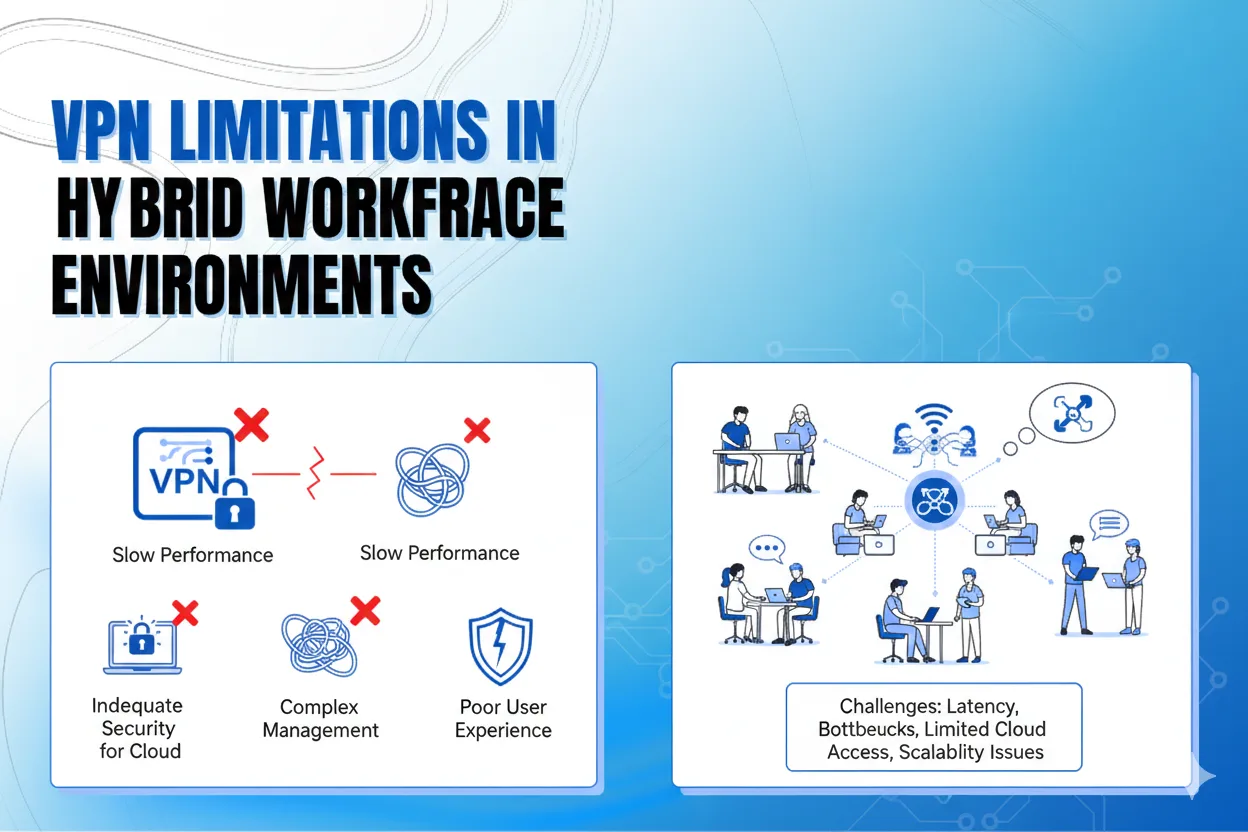
VPN Infrastructure Is Breaking Under Hybrid Workforce Demands
Hybrid work has permanently changed how enterprises operate. Employees now access business applications from corporate offices, homes, co-working spaces, and mobile networks. Traditional VPN infrastructure was designed for occasional remote access, not continuous, enterprise-wide distributed connectivity.
As hybrid workforce environments expand across India, VPN gateways are becoming performance bottlenecks. Employees experience slow application access, unstable connectivity, and inconsistent performance when accessing cloud platforms such as Microsoft 365, Salesforce, and enterprise ERP systems.
More importantly, VPN security models expose enterprise networks to unnecessary risk. VPNs grant network-level access instead of application-level access, increasing the attack surface. For distributed enterprises, this creates operational, security, and scalability limitations.
These VPN limitations in hybrid workforce environments are forcing enterprises to adopt modern secure access models such as Secure Access Service Edge (SASE), which provides secure, scalable, and identity-based access without relying on legacy VPN infrastructure.
Why VPN Architecture Is Not Designed for Hybrid Workforce Environments
VPN architecture was built when enterprise applications were hosted inside corporate data centers. Today, most applications are hosted in public cloud environments. VPN routing models are inefficient for cloud access.
VPN Creates Performance Bottlenecks and Latency Issues
VPN connections route user traffic through centralized VPN gateways before accessing applications. This process, known as backhauling, increases latency and degrades application performance.
Common performance issues include:
Slow access to SaaS applications
Increased login times
Session disconnects
Reduced productivity for remote employees
For enterprises operating across multiple regions in India, VPN latency is even more pronounced due to network routing inefficiencies.
Modern enterprises require direct, secure access to applications without routing traffic through centralized gateways.
VPN Scalability Is Limited for Distributed Enterprise Workforces
VPN infrastructure relies on physical or virtual gateway appliances. As the number of remote users increases, VPN gateways become overloaded.
This creates challenges such as:
Limited concurrent user capacity
Need for hardware upgrades
Increased infrastructure cost
Operational complexity
Hybrid workforce environments require scalable access solutions that support thousands of users without performance degradation.
VPN architecture cannot scale efficiently for modern enterprise needs.
VPN Security Model Increases Enterprise Risk Exposure
VPNs were designed to provide secure connectivity but do not align with modern Zero Trust security principles.
VPN Provides Network-Level Access Instead of Application-Level Access
Once users authenticate through VPN, they often gain access to large portions of enterprise network infrastructure. This increases risk in case of compromised credentials.
Attackers can move laterally across networks after gaining VPN access.
This is one of the most critical VPN security limitations.
VPN Expands Attack Surface in Hybrid Workforce Environments
VPN gateways are exposed to the internet, making them a common attack target. Cyber attackers frequently exploit VPN vulnerabilities to gain unauthorized access.
Security risks include:
Credential theft attacks
VPN gateway vulnerabilities
Unauthorized network access
Lateral movement inside networks
Distributed workforce environments increase exposure to these risks.
Limited Security Visibility and Access Control
VPN infrastructure lacks granular visibility into user activity and application access. Security teams struggle to enforce identity-based policies.
This creates compliance and monitoring challenges.
Modern enterprises require centralized visibility and identity-based access control.
Operational and Management Challenges of VPN Infrastructure
Managing VPN infrastructure across distributed enterprise environments creates operational complexity.
Common challenges include:
Managing multiple VPN gateways
Monitoring user access across locations
Handling frequent connectivity issues
Managing VPN client software across devices
This increases operational overhead for IT teams.
NetNXT, an enterprise IT services provider, helps organizations modernize remote access architecture to eliminate VPN limitations and improve operational efficiency.
VPN vs SASE Comparison for Hybrid Workforce Security
Feature | VPN | SASE |
|---|---|---|
Access Model | Network-level | Identity-based |
Scalability | Limited | Highly scalable |
Performance | High latency | Optimized routing |
Security | Basic encryption | Integrated security stack |
Cloud Access | Inefficient | Optimized |
Management | Complex | Centralized |
SASE architecture addresses VPN limitations by delivering secure access through cloud-native infrastructure.
How SASE Enables Secure Hybrid Workforce Connectivity
Secure Access Service Edge (SASE) provides modern secure access architecture designed for distributed enterprise environments.
Zero Trust Access Model Eliminates VPN Security Risks
SASE uses Zero Trust Network Access to provide application-level access instead of network-level access.
Users can access only authorized applications.
This significantly reduces attack surface.
Cloud-Native Architecture Improves Performance
SASE platforms route traffic through nearest cloud Points of Presence instead of centralized gateways.
This improves:
Application performance
Connectivity reliability
User experience
Employees can securely access applications from any location.
Simplified Management and Centralized Policy Enforcement
SASE platforms provide centralized management of access policies, security controls, and connectivity.
This simplifies operations and improves security visibility.
NetNXT delivers managed security services to help enterprises deploy and manage SASE platforms such as Cato Networks, ensuring secure and scalable remote access for hybrid workforce environments.
Implementation Considerations When Replacing VPN with SASE
Enterprises should follow structured migration approach when transitioning from VPN to SASE.
Assess Existing VPN Infrastructure
Evaluate VPN capacity, performance, and security limitations.
Identify migration priorities.
Implement Phased Migration
Gradually migrate users and applications to SASE architecture.
Ensure operational continuity.
Optimize Security and Access Policies
Define identity-based access policies aligned with enterprise security requirements.
NetNXT, a network security provider specializing in secure access transformation, helps enterprises deploy Zero Trust and SASE architecture aligned with hybrid workforce security requirements.
Why Enterprises Are Moving Beyond VPN to Cloud-Native Secure Access
Hybrid workforce environments require secure, scalable, and high-performance access architecture.
VPN infrastructure cannot support modern enterprise connectivity requirements.
SASE provides secure access aligned with cloud-first enterprise environments.
Organizations adopting SASE improve:
Security posture
User productivity
Network performance
Operational efficiency
To understand complete SASE architecture and migration strategy, read the complete guide on SASE solutions for Indian enterprises.
Talk to a Secure Access Specialist at NetNXT
If your organization is experiencing VPN performance or security challenges, NetNXT can help you transition to a modern secure access architecture.
Connect with a NetNXT security consultant to evaluate your remote access infrastructure and design a scalable SASE deployment tailored to your hybrid workforce.
FAQ
1) Why are VPNs not suitable for hybrid workforce environments?
VPNs create performance bottlenecks, increase security risks, and cannot scale efficiently for large distributed workforces.
2) Is SASE more secure than VPN?
Yes. SASE uses Zero Trust access model, reducing attack surface and improving security compared to VPN.
3) Can SASE fully replace VPN?
Yes. SASE eliminates the need for VPN by providing secure, identity-based access to applications.
4) Does VPN affect application performance?
Yes. VPN routing increases latency, reducing application performance and user productivity.
5) How can enterprises migrate from VPN to SASE?
Migration involves infrastructure assessment, phased deployment, and policy optimization.