
SASE Solutions for Indian Enterprises: Architecture, Implementation & Cost Guide
Why SASE Solutions Are Becoming Critical for Indian Enterprises
Enterprise networks in India are undergoing a structural shift. Applications have moved from data centers to the cloud. Workforces operate across offices, homes, and mobile environments. Branch offices are expanding beyond metro cities into Tier-2 and Tier-3 regions. Traditional network security models built around MPLS, VPNs, and perimeter firewalls are no longer designed for this reality.
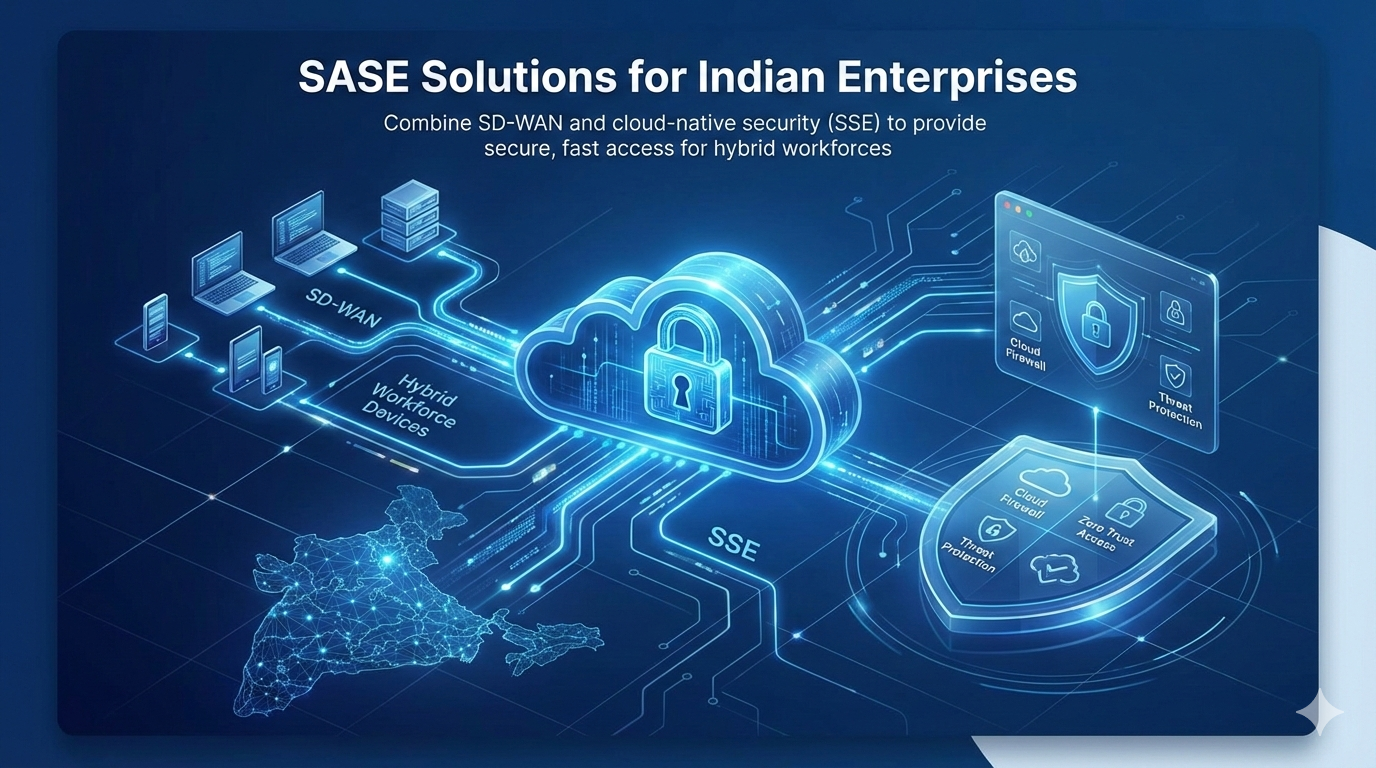
SASE solutions, or Secure Access Service Edge, provide a cloud-native architecture that integrates networking and security into a unified platform. Instead of routing traffic through centralized data centers, SASE delivers secure, optimized connectivity directly from users and branches to applications, regardless of location. This improves performance, reduces cost, and strengthens security posture.
For Indian enterprises, this shift is especially important due to rising MPLS costs, inconsistent ISP performance across regions, increasing SaaS adoption, and growing cyber threats targeting distributed infrastructure. Organizations across manufacturing, financial services, logistics, and eCommerce are adopting SASE architecture to simplify operations and improve user experience.
SASE solutions for Indian enterprises enable secure, scalable connectivity while reducing dependence on legacy network infrastructure. Platforms such as Cato Networks provide cloud-native SASE frameworks that allow enterprises to replace MPLS, modernize security architecture, and support cloud-first operations.
This guide explains SASE architecture, implementation models, cost structure, migration strategy, and enterprise use cases specifically relevant to Indian organizations.
Why Traditional Enterprise Network Architecture Is Breaking
Legacy enterprise network architecture was designed for centralized IT environments. Applications resided in data centers, users operated from office locations, and security controls were enforced at the perimeter. This model is no longer viable.
MPLS Limitations in Modern Enterprise Environments
Multiprotocol Label Switching (MPLS) has historically provided reliable connectivity between enterprise branches and data centers. However, MPLS introduces several operational and financial limitations:
High recurring bandwidth cost, especially across geographically distributed branches in India
Long provisioning timelines, often taking weeks or months for new branch deployment
Limited scalability for rapidly expanding enterprise networks
Inefficient routing of cloud-bound traffic through centralized infrastructure
As Indian enterprises expand into new regions, MPLS creates cost and scalability bottlenecks.
VPN Scalability and Security Challenges
Virtual Private Networks (VPNs) were designed to provide secure remote access. However, VPNs introduce multiple limitations in modern enterprise environments:
VPN concentrators create performance bottlenecks
Increased latency due to backhauling traffic through central gateways
Lack of granular identity-based access control
Expanded attack surface due to network-level access permissions
VPN-based security models are difficult to scale for large distributed workforces.
Branch Sprawl and Network Complexity
Enterprise expansion across India introduces network complexity:
Multiple ISP providers across locations
Variable network reliability across Tier-2 and Tier-3 cities
Fragmented network security policies
Complex network management overhead
Traditional network architecture requires deploying hardware appliances at each branch, increasing operational burden.
SaaS Access and Cloud Performance Issues
Enterprise applications such as Microsoft 365, Salesforce, SAP Cloud, and AWS-hosted platforms are accessed over the internet. Traditional architectures route traffic through centralized firewalls, increasing latency and degrading user experience.
This architecture introduces:
Higher latency for SaaS applications
Increased bandwidth consumption at central data centers
Poor application performance for remote users
Latency and Connectivity Challenges in India
Network routing inefficiencies are more pronounced in India due to ISP variability and geographic distances between branches and data centers. Backhauling traffic increases latency and negatively impacts productivity.
SASE architecture addresses these limitations by providing direct, secure connectivity to applications without reliance on centralized infrastructure.
Also Read: SASE Architecture Blueprint for Indian Enterprises
SASE Architecture Deep Dive
SASE architecture integrates networking and security services into a cloud-delivered platform. Instead of deploying hardware appliances across branches, security and networking functions are delivered through cloud Points of Presence (PoPs).
Core Components of SASE Architecture
SASE platforms integrate multiple security and networking capabilities:
Secure Web Gateway (SWG): Provides web traffic filtering, malware protection, and policy enforcement for internet-bound traffic.
Cloud Access Security Broker (CASB): Provides visibility and control over SaaS applications, enforcing security policies and preventing data leakage.
Zero Trust Network Access (ZTNA): Provides identity-based access control to applications. Users are granted access only to authorized applications, not the entire network.
Firewall as a Service (FWaaS): Delivers firewall protection from the cloud, eliminating the need for hardware firewalls at branch locations.
SD-WAN Integration: Optimizes network routing across multiple connectivity options, improving performance and availability.
Cloud-Native Security Model
Unlike traditional hardware-based architecture, SASE operates entirely in the cloud. Traffic is routed to the nearest SASE Point of Presence, where security inspection and policy enforcement occur.
Platforms such as Cato Networks operate global private backbones with distributed Points of Presence. This allows enterprises in India to route traffic through optimized, secure infrastructure instead of relying solely on public internet routing.
This model provides:
Reduced latency
Improved application performance
Consistent security enforcement
Simplified network management
Enterprise Traffic Flow in SASE Architecture
Traffic flow in SASE architecture follows this sequence:
User or branch initiates connection
Traffic is routed to nearest SASE Point of Presence
Security inspection occurs including firewall, CASB, and threat protection
Traffic is routed to application through optimized path
Response is delivered securely to user
This eliminates backhauling traffic through centralized data centers.
Architecture Comparison: MPLS vs VPN vs SASE
Feature | MPLS | VPN | SASE |
|---|---|---|---|
Deployment Model | Hardware-based | Gateway-based | Cloud-native |
Scalability | Limited | Moderate | High |
Security Integration | Separate tools | Limited | Fully integrated |
Cloud Performance | Poor | Moderate | Optimized |
Cost Efficiency | Low | Moderate | High |
Deployment Speed | Slow | Moderate | Fast |
SASE provides unified networking and security architecture optimized for modern enterprise environments.
SASE Implementation Model for Indian Enterprises
Implementing SASE requires structured planning and phased deployment.
Phase 1: Assessment and Readiness Evaluation
This phase evaluates existing infrastructure including:
MPLS network architecture
VPN deployments
Application hosting environments
Security architecture
User access patterns
NetNXT architects conduct readiness assessments to identify migration risks, performance requirements, and security gaps.
This phase defines implementation roadmap and migration priorities.
Phase 2: Architecture Design
This phase defines enterprise SASE architecture:
Branch connectivity model
User access control policies
Security inspection requirements
Network routing optimization strategy
Platforms such as Cato Networks provide unified SASE platforms that simplify architecture design by integrating networking and security into a single framework.
Phase 3: Pilot Deployment
Pilot deployment is conducted on selected branches or user groups.
This phase validates:
Connectivity performance
Security policy enforcement
Application accessibility
User experience
Pilot deployment minimizes migration risks.
Phase 4: Migration from MPLS and VPN Infrastructure
Migration is conducted in phases to avoid operational disruption.
Migration activities include:
Deploying SASE edge devices at branches
Redirecting traffic to SASE cloud platform
Decommissioning legacy MPLS circuits where feasible
Migrating VPN users to ZTNA access
NetNXT ensures controlled migration aligned with enterprise operational requirements.
Phase 5: Optimization and Continuous Monitoring
After deployment, optimization improves performance and efficiency:
Traffic routing optimization
Security policy tuning
Bandwidth utilization optimization
User experience monitoring
Continuous monitoring ensures long-term performance.
Cost Considerations for SASE Deployment in India
Cost is one of the primary drivers for SASE adoption.
CAPEX vs OPEX Comparison
Traditional network architecture requires capital expenditure for hardware, including firewalls, routers, and VPN gateways.
SASE operates on subscription model.
Cost Component | Traditional Model | SASE Model |
|---|---|---|
Hardware | High | None |
Maintenance | High | Included |
Scaling Cost | High | Low |
Upgrade Cost | High | Included |
Deployment Cost | High | Low |
SASE converts capital expenditure into predictable operational expenditure.
Bandwidth Optimization and MPLS Cost Reduction
MPLS circuits are significantly more expensive than broadband internet.
SASE enables enterprises to replace MPLS with broadband connectivity while maintaining security and performance.
This reduces network cost significantly.
Operational Cost Reduction
SASE reduces operational cost by eliminating:
Hardware maintenance
Manual security management
Complex network infrastructure
Centralized cloud management improves efficiency.
Industry Use Cases for SASE in India
eCommerce Enterprises
eCommerce companies require secure connectivity across warehouses, offices, and cloud infrastructure.
SASE provides:
Secure branch connectivity
Fast cloud access
Protection against cyber threats
Manufacturing Enterprises
Manufacturing organizations operate distributed plants across India.
SASE enables secure connectivity across plants while improving network performance.
FinTech and Financial Services
Financial institutions require strong security and compliance.
SASE provides identity-based access control and advanced threat protection.
Logistics and Supply Chain
Logistics companies operate across multiple locations.
SASE provides secure, reliable connectivity across distributed infrastructure.
Why Enterprises Are Choosing Cato Networks SASE Platform
Cato Networks provides cloud-native SASE architecture designed for enterprise environments.
Key advantages include:
Global private backbone
Integrated security stack
Simplified management
Optimized performance
NetNXT helps enterprises deploy and optimize Cato Networks SASE solutions aligned with operational requirements.
Conclusion: SASE Is the Future of Enterprise Network Architecture
Enterprise network architecture is evolving rapidly. Traditional MPLS and VPN models cannot support modern cloud-first enterprise environments.
SASE solutions provide secure, scalable, and cost-effective architecture designed for modern enterprise operations.
Indian enterprises adopting SASE architecture improve security, reduce cost, and enhance performance.
NetNXT helps enterprises design, implement, and optimize SASE solutions using platforms such as Cato Networks.
Schedule a SASE Readiness Assessment
Evaluate your current network architecture and identify the right migration strategy.
Talk to a NetNXT Network Security Architect to design a secure and scalable SASE architecture aligned with your enterprise requirements.
FAQ
1) What is the cost of SASE deployment in India?
SASE cost depends on number of users, branches, and bandwidth requirements. However, most enterprises reduce network and security costs compared to MPLS and hardware-based security.
2) How long does SASE implementation take?
Typical implementation takes 4 to 12 weeks depending on enterprise size and migration complexity.
3) Can SASE replace VPN infrastructure?
Yes. SASE uses Zero Trust Network Access to replace VPN and provide more secure application access.
4) Does SASE improve performance?
Yes. SASE routes traffic through optimized cloud infrastructure, reducing latency.
5) How does SASE compare to traditional network security?
SASE integrates networking and security into a single platform, improving efficiency and security.