
UEM vs MDM vs EMM: What’s the Difference and What Do You Actually Need
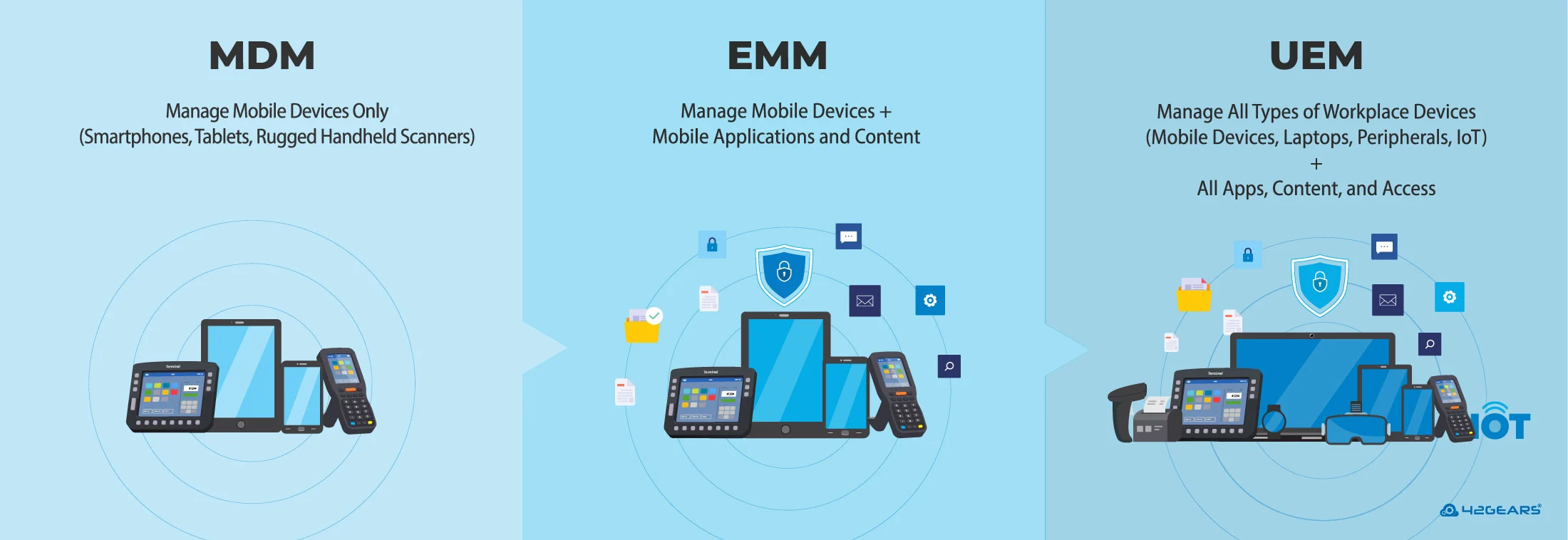
The rise of hybrid and mobile work has completely transformed how organizations manage and secure devices. From laptops and smartphones to IoT devices and virtual endpoints, the diversity of connected assets has exploded. With this, IT teams often face a crucial question:
Should we adopt MDM, EMM, or go all-in with UEM?
While these terms often overlap, understanding their distinctions — and where each fits into your IT strategy — is essential for making the right investment. Let’s break it down clearly.
What’s the Difference Between UEM, MDM, and EMM?
1. Mobile Device Management (MDM)
MDM was the foundation of enterprise mobility. It focuses on controlling and securing mobile devices — primarily smartphones and tablets.
With MDM, IT administrators can:
Remotely configure and manage mobile devices
Enforce security policies like passcodes and encryption
Track, lock, or wipe devices in case of theft or loss
Where it fits:
MDM works best for organizations that mainly manage mobile devices and have basic needs for device control. However, as workforces evolved beyond mobile-only, MDM began to show its limitations.
2. Enterprise Mobility Management (EMM)
EMM evolved from MDM, offering a broader scope that covers devices, applications, and content. It introduced layers of control over not just the device itself, but also the data and apps it holds.
An EMM solution typically includes:
Mobile Application Management (MAM) for app-level control
Mobile Content Management (MCM) to secure files and documents
Identity and Access Management (IAM) integration for user-level security
Where it fits:
EMM is ideal for organizations that require granular control over mobile environments, app usage, and data sharing — but still focus primarily on mobile platforms.
3. Unified Endpoint Management (UEM)
UEM represents the next evolution. It extends management beyond mobile devices to all endpoints — laptops, desktops, servers, IoT devices, and even virtual machines.
A modern UEM solution unifies policies, monitoring, and security across every endpoint in one platform.
With UEM, IT teams can:
Manage all devices — Windows, macOS, Linux, Android, iOS — from one console
Enforce Endpoint Management policies through automation
Integrate advanced tools like SentinelOne for real-time threat protection
Simplify compliance through centralized policy enforcement
Support Zero-Touch Deployment and remote management
Where it fits:
UEM is designed for the modern enterprise — one that’s hybrid, mobile, and cloud-connected. It provides the most holistic visibility, control, and automation for IT and security teams.
What Do You Actually Need?
Choosing between MDM, EMM, and UEM depends on your organization’s structure, workforce model, and risk tolerance.
If your business manages only corporate smartphones: MDM is a cost-effective choice. It gives control over devices and basic protection for data on the go.
If you support a mobile-first workforce: EMM fits better. It offers more granular app and data control — essential for mobile-heavy operations such as logistics, healthcare, or sales teams.
If your workforce is hybrid or BYOD-based: You need UEM. It’s the most comprehensive solution to manage and secure diverse devices, identities, and networks across multiple platforms.
How JumpCloud and SentinelOne Simplify the UEM Landscape
At NetNXT, we combine best-in-class platforms like JumpCloud and SentinelOne to build end-to-end endpoint management and security ecosystems.
JumpCloud serves as a unified platform that integrates device management, identity management, and access control across all operating systems. It helps IT teams automate policies, apply Zero-Touch Deployment, and simplify compliance workflows.
SentinelOne, on the other hand, delivers autonomous Endpoint Security powered by AI. It detects, prevents, and remediates threats in real-time — protecting devices even when offline.
Together, JumpCloud + SentinelOne, deployed and optimized by NetNXT, give businesses complete control and peace of mind over their entire endpoint environment — without the complexity.
Explore how NetNXT can help you unify and secure your device ecosystem today.
The Real Impact of Moving to UEM
Migrating to UEM isn’t just about consolidation — it’s about transformation.
IT teams gain time through automation
Compliance audits become easier with centralized visibility
Security incidents reduce significantly through integrated endpoint protection
Employees experience seamless, secure access regardless of device or location
By adopting UEM, businesses future-proof their infrastructure for the realities of distributed work, compliance, and cybersecurity threats.
Talk to NetNXT experts today to assess your current setup and find the right-fit strategy for your organization.
FAQs
1. What’s the key difference between MDM, EMM, and UEM?
MDM manages mobile devices, EMM expands control to mobile apps and content, while UEM unifies management across all endpoints — laptops, desktops, mobile, and IoT.
2. Why should I upgrade from MDM or EMM to UEM?
As workforces become more hybrid, UEM provides holistic visibility and control across all devices. It reduces management overhead while improving security and compliance.
3. How does SentinelOne enhance UEM?
SentinelOne offers autonomous endpoint protection using AI-driven detection and response, which integrates with UEM platforms like JumpCloud for a complete defense system.
4. How can NetNXT help with UEM deployment?
NetNXT helps businesses assess, deploy, and optimize solutions like JumpCloud and SentinelOne to simplify endpoint management, enhance security, and meet compliance goals.