
SD-WAN Types in 2026: Cloud-Delivered vs On-Prem vs Hybrid vs SASE-Integrated, Which One Fits Your Network?
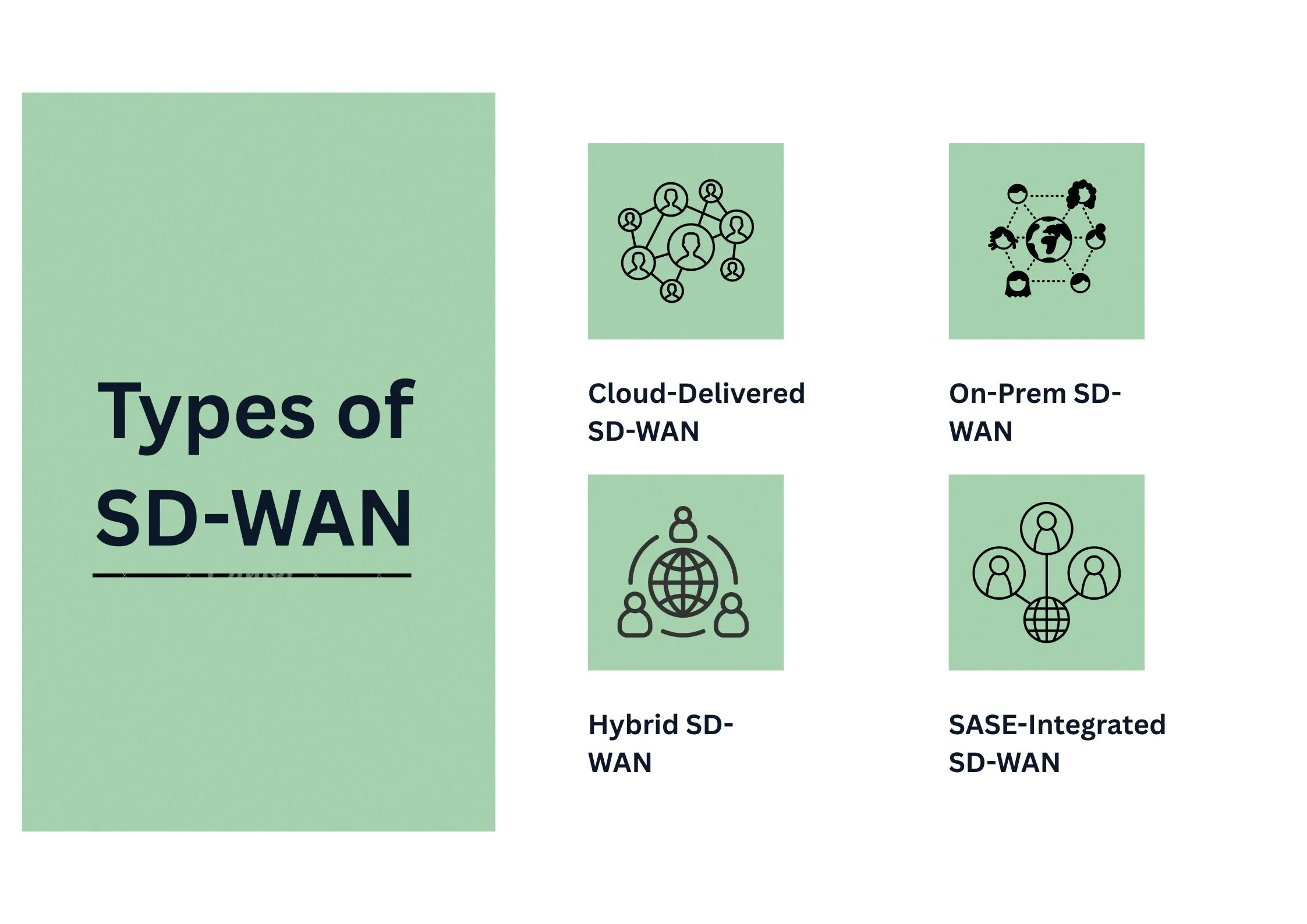
What are the major types of SD-WAN in 2026?
There are four enterprise-ready SD-WAN models used today: Cloud-Delivered SD-WAN, On-Prem SD-WAN, Hybrid SD-WAN, and SASE-Integrated SD-WAN.
Each solves routing and connectivity differently, and the right choice depends on scale, security ownership, latency needs, and operational bandwidth.
How does Cloud-Delivered SD-WAN work, and when is it best?
Cloud-Delivered SD-WAN routes traffic through a vendor’s global cloud network instead of private MPLS circuits.
The orchestrator lives in the cloud, pushing policies to all branch edges over the internet.
Best for: 20-150+ branches, remote workforces, SaaS-heavy traffic, and multi-cloud routing where private circuits slow deployment.
What problems it solves
High MPLS circuit cost
SaaS latency due to forced backhaul
Slow branch onboarding
No central visibility across links
No automatic failover on internet or 5G
Where it struggles
Enterprises still need to integrate ZTNA or MDR for security ownership
Needs stable internet + secondary 5G/LTE for best results
Real packet path
Branch user → SD-WAN edge → nearest cloud PoP → cloud/SaaS app.
Cato Networks delivers strong cloud PoP routing for distributed WAN performance and lower SaaS latency when SD-WAN is used inside its SASE fabric.
What is On-Prem SD-WAN, and why do some enterprises still use it?
On-Prem SD-WAN keeps the orchestrator inside the enterprise datacenter.
Policies are controlled by internal network or security teams, not the vendor cloud.
Best for: Organizations that must keep traffic control planes and logs in-country or in private DC due to regulatory requirements, or when cloud exits are restricted.
What problems it solves
Centralized policy control without internet dependency on the vendor cloud
Full internal ownership of WAN configuration
What it does NOT solve
Does not optimize cloud routing as efficiently as cloud PoPs
24/7 security monitoring still needs internal SOC or outsourced MDR
SaaS latency remains higher than cloud-exit SD-WAN
Real packet path
Branch user → SD-WAN edge → enterprise DC → cloud/SaaS (higher latency than cloud PoP model).
Cisco Meraki SD-WAN edges are often chosen here because of strong centralized orchestration and large fleet management capabilities.
What is Hybrid SD-WAN, and why is it the most common model in 2026?
Hybrid SD-WAN mixes internet links, MPLS (if still present), and 5G/LTE under a single overlay network, with orchestration running both in cloud and private DC.
Best for: Large fleets (500-5000+ users), 50+ branches, multi-cloud environments, and teams that want performance without losing internal governance.
What problems it solves
Link aggregation across fiber + LTE/5G
40-70% SaaS latency reduction
30-60% WAN cost savings
70-90% faster failover than MPLS-only WAN
Centralized dashboards for link health, jitter, packet loss
Where it struggles
Identity + device trust still needs IAM/UEM integration
Security ownership after hours needs MDR/SOC
Real packet path
Branch user → SD-WAN edge → best live link → nearest cloud PoP or DC → cloud/SaaS.
What is SASE-Integrated SD-WAN, and why is it dominating 2026 enterprise buying?
SASE-Integrated SD-WAN embeds SD-WAN routing inside a SASE fabric that includes ZTNA, SWG, Firewall, API inspection, and Data Protection in one place.
Best for: Security Heads, VP of IT, and Network Operations teams managing 1000-10,000+ users across multiple locations who want Zero Trust + cloud inspection + 24/7 breach ownership.
What problems it solves
Uncontrolled API and microservices traffic visibility
SaaS + cloud routing inefficiencies
Policy inconsistency across branches
Lateral movement attacks via VPN
Endpoint drift causing audit failures
After-hours breaches going undetected
Real packet path
Remote/Branch user → ZTNA → SASE PoP → WAAP/API inspection → SaaS/Cloud.
Where it struggles
Still needs proper baseline policies and detection tuning
Cost varies by user, endpoint, and add-on security modules
Cato Networks is widely chosen here for SASE-embedded SD-WAN with global PoP routing and inline security inspection.
SentinelOne feeds endpoint telemetry into MDR/SOC correlation workflows when SD-WAN is paired with XDR or AI SIEM stacks.
Cloud SD-WAN vs Hardware SD-WAN vs Software Edge vs SASE-based SD-WAN, what is the difference?
SD-WAN Type | Delivery Model | Security Ownership | Cloud Exit Optimization | Best for Scale | Complexity | Typical Cost |
|---|---|---|---|---|---|---|
Cloud-Delivered | Vendor Cloud Orchestrator | Internal + MDR recommended | Strong | 20-150+ sites | Medium | $$ (per user/branch) |
Hardware SD-WAN | Appliance Edge + Cloud/On-Prem Orchestrator | Internal + MDR recommended | Medium | 10-100+ branches | High | $$$ (hardware cost + license) |
Software Edge | Virtual Edge + Cloud Orchestrator | Internal + MDR recommended | Strong | 100-5000+ remote users | Medium | $$ |
SASE-based SD-WAN | SD-WAN inside SASE PoP | Vendor + MDR ownership | Strongest | 500-10,000+ users | Medium | $$$ (bundled per user + add-ons) |
Which SD-WAN type should an Indian enterprise choose in 2026?
Choose Cloud-Delivered SD-WAN if you want fast rollout and cloud exits, and have internal SOC or MDR for breach ownership.
Choose On-Prem if regulations require private DC control planes.
Choose Hybrid if you have 50+ branches and want link aggregation + central policies.
Choose SASE-Integrated SD-WAN if you want Zero Trust + API inspection + 24/7 threat ownership.
What does a 2026 enterprise SD-WAN recommendation matrix look like?
Company Need | Recommended SD-WAN Model |
|---|---|
1000+ remote users + multi-cloud | SASE-Integrated SD-WAN |
20-150+ branches, SaaS heavy | Cloud-Delivered or Hybrid |
RBI, CERT-In, ISO evidence tagging | Hybrid or SASE-Integrated |
No internal SOC after hours | MDR + SASE SD-WAN |
DevOps microservices traffic visibility | SASE-Integrated SD-WAN |
2026 Deployment Takeaways
SD-WAN improves performance, uptime, and routing consistency, but security ownership after hours must come from MDR/SOC or ZTNA.
Enterprises that want Zero Trust + cloud API inspection + multi-site routing + compliance evidence tagging are moving to SASE-embedded SD-WAN.
Teams that skip app mapping, failover drills, identity fusion, or compliance tagging later search for fixes. Covering these in content increases ranking relevance.
FAQ
1) Is SD-WAN alone enough for 24/7 security?
No. SD-WAN handles routing, but breaches after hours need MDR/SOC ownership for detection and containment.
2) Can SD-WAN prevent lateral movement attacks?
Not by itself. It reduces network choke points, but lateral movement prevention requires ZTNA or identity-based segmentation.
3) Which logs should SD-WAN integrate for compliance?
Critical app logs, identity logs, link health, cloud exit telemetry, and configuration drift evidence for audits.
4) Does SD-WAN replace traditional firewalls?
No. It simplifies routing and policy delivery, but firewall enforcement must still be deployed inline or via SASE-based inspection.