
Why MPLS Is Failing Distributed Enterprises in India and What Comes Next
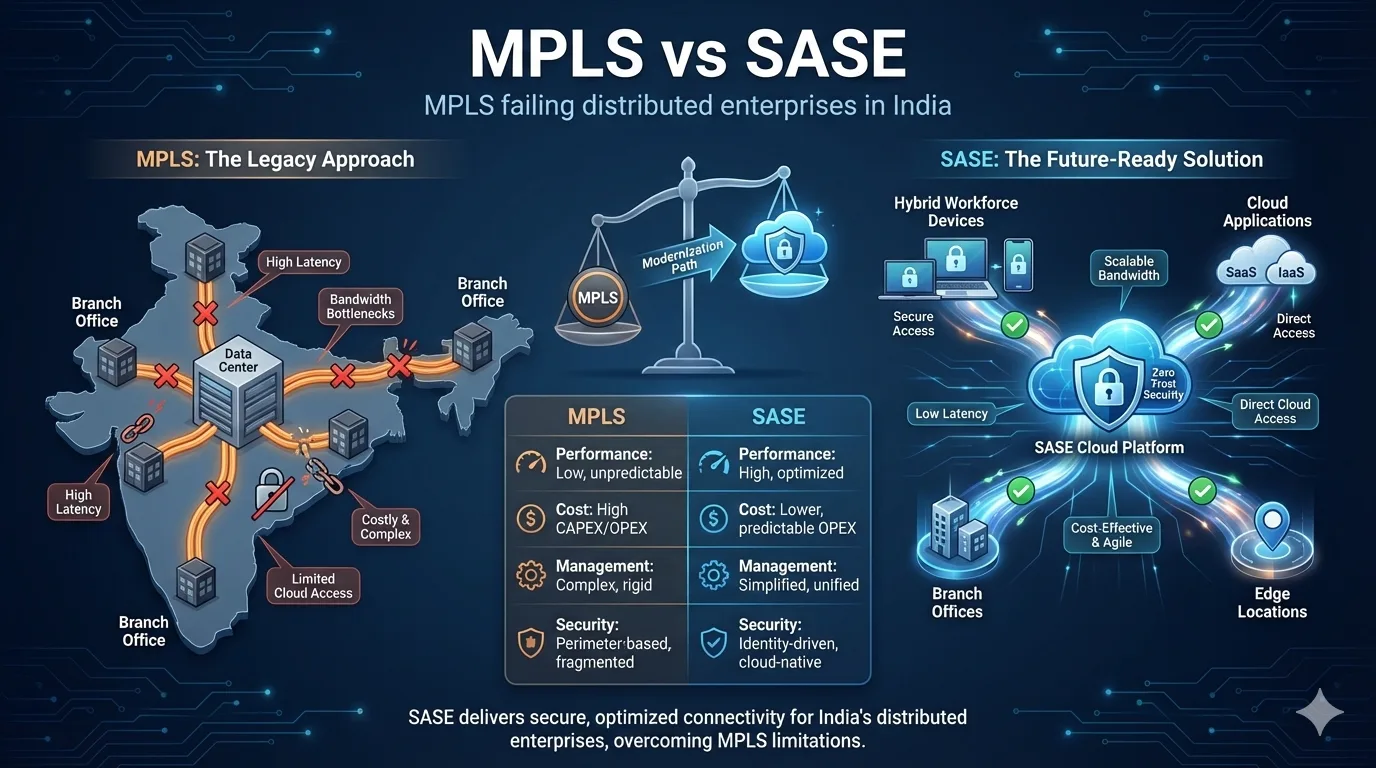
MPLS Is Becoming a Bottleneck for Distributed Enterprise Growth in India
Distributed enterprises across India are facing growing network performance, scalability, and security challenges. MPLS networks, once considered the backbone of enterprise connectivity, are now limiting business agility. Organizations operating across multiple branches, manufacturing plants, logistics hubs, and regional offices are experiencing increased latency, rising connectivity costs, and operational complexity.
The shift to cloud applications, hybrid work environments, and geographically distributed operations has exposed fundamental weaknesses in MPLS architecture. Enterprises relying on MPLS struggle to deliver consistent performance for SaaS applications, secure remote access, and scalable connectivity for expanding branch infrastructure.
This is why MPLS is failing distributed enterprises in India. The architecture was designed for centralized IT environments, not cloud-first, distributed business models. Enterprises now require secure, flexible, and scalable connectivity that aligns with modern application access patterns.
As organizations reassess their network strategy, cloud-native architectures such as Secure Access Service Edge (SASE) are replacing MPLS to provide secure and optimized enterprise connectivity.
The Real Limitations of MPLS in Distributed Enterprise Environments
MPLS Cannot Support Cloud-First Enterprise Operations
MPLS was designed to connect branch offices to centralized data centers. However, enterprise applications have shifted to cloud platforms such as Microsoft 365, AWS, Salesforce, and SAP Cloud. When MPLS routes traffic through centralized data centers before reaching cloud services, it creates inefficient traffic paths.
This results in:
Increased application latency
Poor performance for SaaS platforms
Reduced productivity for remote and branch users
Indian enterprises operating across multiple regions face even greater performance degradation due to geographic distance and ISP routing inefficiencies.
Cloud-native security and connectivity models require direct, secure access to applications, which MPLS cannot provide efficiently.
MPLS Cost Is No Longer Sustainable for Enterprise Expansion
MPLS connectivity is significantly more expensive compared to broadband and cloud-native connectivity models. As enterprises expand into Tier-2 and Tier-3 cities across India, MPLS cost becomes a major operational burden.
Key cost challenges include:
High recurring bandwidth costs
Expensive provisioning for new branches
Long-term contractual commitments
Limited flexibility for bandwidth scaling
Distributed enterprises need connectivity models that scale cost-effectively without increasing operational overhead.
MPLS Deployment and Scaling Are Slow and Operationally Restrictive
Enterprise expansion requires rapid deployment of secure connectivity. MPLS provisioning timelines can range from several weeks to months, delaying branch activation and operational readiness.
This creates challenges such as:
Delayed branch deployments
Reduced business agility
Increased operational complexity
Limited ability to scale network infrastructure quickly
Modern enterprises require connectivity solutions that support rapid deployment and scalability.
Why MPLS Security Model Is No Longer Effective for Enterprise Networks
MPLS provides network isolation but does not provide integrated security. Enterprises must deploy separate security tools such as firewalls, VPN gateways, and threat protection systems.
This fragmented architecture creates security gaps.
Lack of Identity-Based Access Control
MPLS operates at the network level, not at the user or identity level. This makes it difficult to enforce granular access control based on user identity.
This increases the risk of unauthorized access.
Limited Visibility Across Distributed Enterprise Infrastructure
Security teams lack centralized visibility across MPLS-connected infrastructure. Monitoring and managing security across multiple branch locations becomes complex and inefficient.
This increases risk exposure.
Increased Attack Surface in Hybrid Work Environments
With hybrid and remote work becoming standard across India, MPLS cannot secure users operating outside branch networks. Enterprises must rely on VPN infrastructure, which introduces additional security and performance challenges.
This fragmented security model increases vulnerability.
MPLS Cannot Support Multi-Site Enterprise Growth in India
Distributed enterprises across India face unique connectivity challenges due to geographic scale and infrastructure variability.
Enterprises operating across manufacturing facilities, warehouses, regional offices, and retail locations require flexible connectivity.
MPLS creates operational limitations including:
Dependency on telecom providers
Limited bandwidth scalability
Poor redundancy options
Complex network management
These limitations slow enterprise growth and increase operational risk.
MPLS vs Modern Enterprise Connectivity Architecture Comparison
Feature | MPLS | Cloud-Native SASE |
|---|---|---|
Scalability | Limited | Highly scalable |
Deployment Speed | Slow | Rapid deployment |
Cloud Performance | Poor | Optimized |
Security Integration | Separate tools required | Integrated security |
Cost Efficiency | High cost | Optimized cost |
Remote Access Support | Limited | Native support |
Cloud-native SASE architecture addresses MPLS limitations by integrating networking and security into a unified platform.
How SASE Solves MPLS Limitations for Distributed Enterprises
Secure Access Service Edge (SASE) provides cloud-native enterprise connectivity designed for modern distributed environments.
Secure and Optimized Branch Connectivity
SASE enables secure branch connectivity without relying on MPLS circuits. Branch traffic is routed through secure cloud Points of Presence, improving performance and security.
This reduces latency and improves application performance.
Zero Trust Security Model
SASE platforms implement Zero Trust Network Access, ensuring users access only authorized applications. This improves enterprise security posture and reduces attack surface.
This model is more secure than traditional network-based access.
Cloud-Native Architecture Designed for Enterprise Scalability
SASE architecture eliminates dependency on physical infrastructure. Enterprises can scale connectivity across branches without deploying hardware or MPLS circuits.
This improves operational agility.
Integrated Security and Network Management
SASE platforms integrate firewall protection, threat prevention, and access control into a unified platform. This simplifies security management and improves visibility.
NetNXT, a network security provider and managed security services provider, helps enterprises design and deploy SASE architecture aligned with their operational requirements. Using platforms such as Cato Networks, NetNXT enables secure, cloud-native connectivity across distributed enterprise environments.
MPLS to SASE Migration Strategy for Distributed Enterprises
Enterprises planning to replace MPLS should consider structured migration strategy.
Infrastructure Assessment
Evaluate existing network architecture, connectivity dependencies, and security infrastructure.
This helps define migration roadmap.
Phased Migration Approach
Migration should be conducted gradually to avoid operational disruption. Branch locations can be migrated in phases.
This ensures business continuity.
Performance and Security Optimization
Traffic routing policies and security configurations must be optimized after deployment to ensure optimal performance.
NetNXT, an IT services provider and enterprise network security provider, helps organizations implement and optimize SASE architecture to replace MPLS infrastructure securely and efficiently.
Why Indian Enterprises Are Migrating from MPLS to SASE
Enterprise network architecture is evolving rapidly. MPLS is no longer capable of supporting distributed enterprise environments.
Cloud-native connectivity models such as SASE provide secure, scalable, and cost-efficient connectivity aligned with modern enterprise requirements.
Indian enterprises adopting SASE architecture improve:
Security posture
Application performance
Operational efficiency
Network scalability
Organizations transitioning from MPLS to SASE gain long-term operational and financial benefits.
To understand how SASE architecture enables secure and scalable enterprise connectivity, read the complete guide on SASE solutions for Indian enterprises.
NetNXT helps enterprises design, implement, and manage SASE architecture using cloud-native platforms such as Cato Networks, providing secure and optimized enterprise connectivity.
FAQ
1) Why is MPLS no longer suitable for modern enterprises?
MPLS was designed for centralized networks, but modern enterprises use cloud applications and distributed workforces. MPLS creates latency, scalability, and cost challenges, making it inefficient for cloud-first environments.
2) Is SASE replacing MPLS in enterprise networks?
Yes. Many enterprises are replacing MPLS with SASE because it provides secure, scalable, and cost-efficient connectivity while improving cloud application performance.
3) What are the biggest limitations of MPLS in India?
High bandwidth cost, slow provisioning, poor cloud performance, and limited scalability are the major limitations of MPLS for Indian enterprises.
4) How does SASE improve enterprise network security?
SASE integrates firewall, Zero Trust access, and threat protection into a unified cloud platform, improving security and reducing attack surface.
5) Can MPLS be fully replaced with SASE?
Yes. Most enterprises can fully replace MPLS using SASE architecture while improving performance, security, and scalability.