
Logistics
Logistics and Supply Chain
How a Growing Logistics Company Resolved Operational Bottlenecks and Improved SLA Adherence by 35% with AI Workflow Automation
The client is a mid-sized logistics and supply chain company operating across multiple cities in India, providing warehousing, transportation, and last-mile delivery services to e-commerce and manufacturing clients.
Over the past few years, the company had experienced steady growth driven by increasing demand and a strong client portfolio. Their long-term vision was to evolve into a technology-led logistics partner capable of delivering predictable, scalable, and efficient operations across regions.
While the business was growing, the internal operational structure had not evolved at the same pace. This created a widening gap between their growth ambitions and their ability to execute consistently.
Key Challenges Hindering Operational Efficiency
Despite investing in core systems such as ERP, warehouse management, and transport management tools, the company was facing persistent operational inefficiencies.
Fragmented Systems and Data Silos
Multiple platforms were being used across functions, but they were not integrated effectively. Order data, inventory status, and delivery updates were often inconsistent across systems.
No unified operational view
Manual reconciliation of data across teams
Increased chances of errors and duplication
Heavy Dependence on Manual Coordination
Critical processes such as dispatch approvals and order updates were still managed through calls, emails, and messaging platforms.
High dependency on human intervention
Delays in execution due to communication gaps
Lack of process standardization
Lack of Real-Time Visibility
There was no centralized system providing real-time insights into operations.
Leadership relied on delayed reports
Limited visibility into order status and bottlenecks
Decisions were reactive rather than proactive
Frequent SLA Breaches
The company had committed delivery timelines to enterprise clients, but there was no structured mechanism to monitor or enforce them.
No automated SLA tracking
Delays identified only after escalation
Increasing client dissatisfaction
Inefficient Exception Handling
When disruptions occurred—such as delays, routing issues, or inventory mismatches—there was no defined process to handle them.
Manual identification and resolution of issues
Lack of accountability and tracking
Extended resolution times
Impact on Business Performance
These operational challenges began to directly affect business outcomes:
Order processing timelines increased by 30–40%
SLA adherence dropped across key client accounts
Operational costs increased due to manual effort
Decision-making slowed due to lack of reliable data
The business struggled to scale efficiently during peak demand periods
At this stage, the issue was not demand or capability—it was the absence of a connected, automated operational framework.
NetNXT Solution: AI-Driven Workflow Automation
NetNXT approached the problem by focusing on end-to-end operational orchestration rather than isolated automation.
The objective was to create a system where workflows, systems, and decision-making processes were interconnected and largely automated.
Solution Architecture and Implementation
End-to-End Workflow Automation
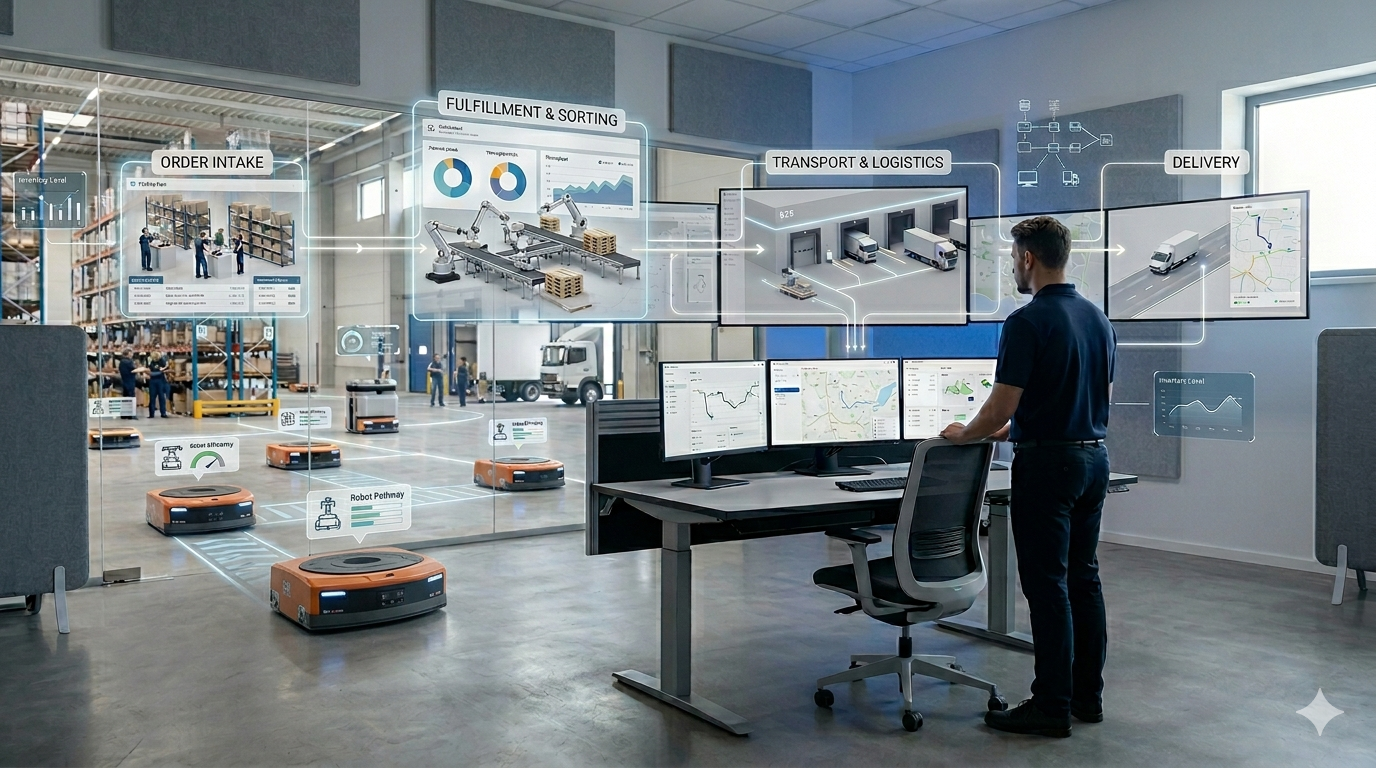
NetNXT designed automated workflows covering the entire lifecycle—from order creation to warehouse processing, dispatch, and delivery.
This reduced dependency on manual handoffs and ensured process continuity.
System Integration Layer
Existing systems, including ERP, warehouse management, and transport management tools, were integrated into a unified workflow environment.
This enabled real-time data synchronization and eliminated inconsistencies across platforms.
AI-Based Exception Detection and Handling
The solution included intelligent mechanisms to identify potential delays and disruptions.
Early detection of issues
Automated escalation to relevant teams
Faster resolution through predefined workflows
SLA Monitoring and Alerting System
SLA tracking was embedded directly into operational workflows.
Real-time monitoring of delivery timelines
Automated alerts before potential breaches
Escalation protocols to ensure accountability
Centralized Operational Dashboard
A unified control layer was introduced to provide real-time visibility across all operations.
Live tracking of orders and dispatch status
Clear visibility into bottlenecks
Data-driven decision-making for leadership
Business Impact and Results
The implementation of AI Workflow Automation led to measurable improvements across operations:
Order processing time reduced by 45%
Manual intervention across workflows decreased by 60%
SLA adherence improved by 35%
Real-time operational visibility enabled faster decision-making
Operational scalability improved significantly during high-demand periods
From a business perspective, the company was able to:
Improve client satisfaction and retention
Reduce operational inefficiencies and costs
Strengthen its positioning as a reliable logistics partner
Support growth without proportional increase in manpower
Conclusion
As logistics operations expand, fragmented systems and manual coordination become critical barriers to efficiency and scalability.
This case demonstrates that the shift from manual, disconnected processes to a structured, automated workflow system is not incremental—it is foundational.
By implementing AI-driven workflow automation, NetNXT enabled the client to move from reactive operations to a controlled, scalable, and predictable operating model.
Struggling with delays and inefficiencies? Talk to NetNXT and streamline your logistics workflows.